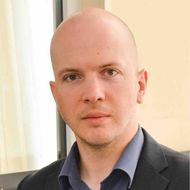
Тимофеев Алексей Владимирович
Московский институт электроники и математики им. А.Н. Тихонова
Профессиональные интересы
Должности
- Ведущий научный сотрудник — Московский институт электроники и математики им. А.Н. Тихонова, Международная лаборатория суперкомпьютерного атомистического моделирования и многомасштабного анализа
- Доцент — Московский институт электроники и математики им. А.Н. Тихонова, Департамент прикладной математики
Био
- · Начал работать в НИУ ВШЭ в 2012 году.
- · Научно-педагогический стаж: 20 лет.
Образование
- 2012 · Кандидат физико-математических наук: Московский физико-технический институт, специальность 01.04.08 «Физика плазмы», тема диссертации: Аномальный разогрев движения пылевых частиц в плазме газового разряда
- 2011 · Аспирантура: Московский физико-технический институт, факультет: МБФ, специальность «физика плазмы»
- 2010 · Магистратура: Московский физико-технический институт, специальность «Прикладные математика и физика», квалификация «Магистр прикладных математики и физики»
Опыт работы
- · 2005: C года занимался исследовательской деятельностью (теоретические исследование, компьютерное моделирование) в области физики плазмы в ОИВТ РАН. Начал с должности стажёра-исследователя, был младшим научным сотрудником (м.н.с.), н.с., с.н.с., зам.зав.лаб, и сейчас работаю в должности заведующего лабораторией теории неидеальной плазмы и заместителем директора по научной работе
- · 2010: С года преподаю в МФТИ
- · 2012: С года преподаю в МИЭМ ВШЭ
Награды и поощрения
- · Награды 1) медаль РАН для студентов высших учебных заведений России за лучшие научные работы в 2010г. 2) Премия «Новая генерация» 2008г. для молодых учёных в области энергетики и смежных наук от РАО "ЕЭС России" 3) Почетная грамота НИУ ВШЭ за лучшую русскоязычную научную работу 2022г. 4) Почетная грамота Минобрнауки 2024г.
- · Надбавка за публикацию в журнале из Списка А (и приравненном к нему научном издании) (2025–2026, 2024–2025, 2023–2024)
- · Надбавка за публикацию в международном рецензируемом научном издании (2022–2023, 2021–2022, 2020–2021, 2019–2020, 2018–2019)
- · Надбавка за статью в зарубежном рецензируемом журнале (2013–2015)
- · Лучший преподаватель — 2018
- · Победитель Конкурса лучших русскоязычных научных и научно-популярных работ работников НИУ ВШЭ – 2022
Гранты и проекты
- — · Гранты РНФ 1) проект №14-50-00124 - участие, 2) проект №20-71-10127 - руководство
Конференции (5)
Показать все
- · 2019: XXXIV International Conference on Interaction of Intense Energy Fluxes with Matter ELBRUS-2019 (Elbrus, Kabardino-Balkaria, Russia). Доклад: Velocities relaxation in LJ system
- · 2018: Supercomputing frontiers Europe (Варшава). Доклад: Elbrus processors performance for fast Fourier transform and computational materials science codes
- · 2017: 8th International Conference on the Physics of Dusty Plasmas (Прага). Доклад: Configuration and Kolmogorov-Sinai entropy in dusty plasma model
- · 2016: Cуперкомпьютерное моделирование в естественных и инженерных науках (Supercomputer Simulations in Science and Engineering) (Москва). Доклад: Parametric resonance and energy transfer in dusty plasma: theory and simulation
- · 2015: DIAGNOSTICS AND SIMULATION OF DUSTY PLASMAS (Киль). Доклад: Divergence of dust particle trajectories and entropy in dusty plasma model
Идентификаторы исследователя
- ORCID:
0000-0003-1156-893X - ResearcherID:
Z-4670-2019 - SPIN РИНЦ:
1035-8880 - Google Scholar: https://scholar.google.ru/citations?user=uuFrrdUAAAAJ&hl=en
- Scopus AuthorID:
57201423009
Публикации (53)
Performance analysis of CUDA, OpenACC and OpenMP programming models on TESLA V100 GPU
2021 · CHAPTER · en
Неоднородность структурных и динамических характеристик пылевой плазмы в газовом разряде
2020 · ARTICLE · ru
Плазменно-пылевые кристаллы принято рассматривать как пространственно-однородные структуры с равными значениями структурных и термодинамических параметров в различных областях системы. Показано, что уже в системе частиц с упрощенной моделью взаимодействия, учитывающей экрани- рованный кулоновский потенциал и параболическую ловушку, возникает неоднородность межчастичного расстояния, амплитуды тепловых колебаний частиц, параметра Линдеманна и параметра неидеальности. Исследуется вопрос о распределении величины кинетической энергии частиц в неоднородном плазменно- пылевом монослое: показано, что из-за неоднородности структурных параметров средняя кинетическая энергия частиц в центральной части структуры может значительно отличаться от средней кинетической энергии частиц на периферии. Обнаруженные эффекты проверяются при помощи аналитических мето- дов и численного моделирования, а также посредством сравнения с плазменно-пылевым экспериментом в тлеющем разряде постоянного тока. Полученные результаты имеют важное значение для исследо- вания конечных систем одноименных зарядов в ловушке и изучения механизма фазовых переходов в плазменно-пылевых системах.
Inhomogeneity of a one-dimensional Yukawa system in a trap
2020 · ARTICLE · en
A system of like charges interacting with a weak repulsive Yukawa potential and confined in a one-dimensional parabolic electrostatic trap is under consideration. It is shown that inter-particle distance in this system grows from the center of the structure to its periphery. The same effect takes place for the mean square displacement of particles from their equilibrium positions, which corresponds to the amplitude of thermal oscillations, and for the value of Lindemann parameter. This leads to different degrees of order for particles located at different distances from the center of the structure. This result might be important for the study of phase transitions in dusty, colloidal and one-component plasmas.
Evaluating OpenMP, OpenACC and CUDA parallel programming models for the GPU: Performance Analysis
2020 · CHAPTER · en
Modern supercomputers use GPUs as accelerators in computing nodes. GPUs allow scientific applications to greatly boost performance using fine-grained parallelism. CUDA programming model oriented to take advantage of the SIMT GPU architecture writing low-level code. Contrary to this approach, OpenACC and OpenMP 4.5 represent a declarative model of parallel programming using compiler pragmas with support of GPU offloading. In this paper the efficiency of matrix multiplication using these programming models is considered. A comparative analysis of the performance of naive and hand tuned matrix multiplication on Nvidia Tesla V100 and MX940 GPUs and modern CPUs is carried out. Analysis of vendor-optimized BLAS libraries is also present.
Inhomogeneity of Structural and Dynamical Characteristics of Dusty Plasma in a Gas Discharge
2020 · ARTICLE · en
© 2019, Pleiades Publishing, Inc.Abstract: Dusty plasma crystals are commonly considered as spatially homogeneous structures with equal values of their structural and thermodynamic parameters in various regions of the system. Inhomogeneity of the interparticle distance, the amplitude of thermal particle oscillations, the Lindemann parameter, and the coupling parameter is shown to arise even in a system of particles with a simplified interaction model including a screened Coulomb potential and a parabolic trap. The kinetic energy distribution for particles in an inhomogeneous dusty plasma monolayer is investigated: it is shown that the mean kinetic energy of particles in the central part of the structure can differ significantly from the mean kinetic energy of particles on its periphery due to the inhomogeneity of structural parameters. The detected effects are verified using analytical methods and numerical simulations and by comparison with a dusty plasma experiment in a dc glow discharge. The results obtained are of great importance for investigating finite systems of like charges in a trap and studying the mechanism of phase transitions in dusty plasma systems.
Angara interconnect makes GPU-based Desmos supercomputer an efficient tool for molecular dynamics calculations
2019 · ARTICLE · en
In this paper, we describe the Desmos supercomputer that consists of 32 hybrid nodes connected by a low-latency highbandwidth Angara interconnect with torus topology. This supercomputer is aimed at cost-effective classical molecular dynamics calculations. Desmos serves as a test bed for the Angara interconnect that supports 3D and 4D torus network topologies, and verifies its ability to unite massively-parallel programming systems speeding-up effectively MPI-based applications. We describe the Angara interconnect presenting typical MPI benchmarks. Desmos benchmarks results for GROMACS, LAMMPS, VASP and CP2K are compared with the data for other HPC systems. Also, we consider the job scheduling statistics for several months of Desmos deployment.
Влияние параметров тлеющего разряда на среднее межчастичное расстояние в плазменно-пылевых структурах в диапазоне температур от криогенных до комнатной
2019 · ARTICLE · ru
При помощи метода молекулярной динамики исследовано влияние сил в пылевой плазме и параметров разряда на среднее межчастичное расстояние в структурах в тлеющем разряде постоянного тока в диапазоне температур 50–300 К. Представлены результаты по зависимости среднего межчастичного расстояния в структурах от температуры нейтрального газа в упрощенной и модифицированной моделях пылевой плазмы. Упрощенная модель включает в себя экранированный кулоновский потенциал и амбиполярную ловушку, в модифицированной модели дополнительно учитываются термофоретическая сила, сила ионного затенения и сила затенения нейтралами. Для расчета всех сил используются взятые из лабораторных экспериментов значения параметров разряда (тока, давления, температуры, рода газа). Данная модифицированная модель плазменно-пылевой системы позволяет объяснить экспериментальную форму зависимости среднего межчастичного расстояния в пылевых структурах от температуры газа разряда. Предложен метод оценки концентрации ионов в разрядном газе по величине среднего межчастичного расстояния в плазменно-пылевых структурах.
Deploying Elbrus VLIW CPU Ecosystem for Materials Science Calculations: Performance and Problems.
2019 · CHAPTER · en
Modern Elbrus-4S and Elbrus-8S processors show floating point performance comparable to the popular Intel processors in the field of high-performance computing. Tasks oriented to take advantage of the VLIW architecture show even greater efficiency on Elbrus processors. In this paper the efficiency of the most popular materials science codes in the field of classical molecular dynamics and quantum-mechanical calculations is considered. A comparative analysis of the performance of these codes on Elbrus processor and other modern processors is carried out.
Inhomogeneity of a harmonically confined Yukawa system
2019 · ARTICLE · en
A crystalline system of strongly screened Yukawa particles in a harmonic trap is under consideration. We show that structural and dynamic properties of confined Yukawa crystals are fundamentally nonuniform. The average interparticle distance, thermal oscillation amplitude, and Lindemann and inverse coupling parameters are found to increase with the radial distance from the center of a structure. We verify the inhomogeneity of these parameters by molecular dynamics simulations and the analytical approach. Analytical formulas are in good agreement with a dusty plasma experiment. The obtained results might be important for the theory of crystal formation and phase transitions in dusty plasmas, colloidal suspensions, and Coulomb crystals.
Divergence of dust particles trajectories in dusty plasma model
2019 · ARTICLE · en
The description of the properties of the plasma–dust system can be improved by using elements of thermodynamics. Divergence of the dusty particles trajectories allows us to estimate Krylov–Kolmogorov–Sinai entropy for a system of dust particles in plasma. In this way, we can verify if the behavior of the K-entropy of the dusty plasma subsystem in the partial equilibrium is close to the physical entropy. A picture of the divergence of trajectories for the dusty plasma model is obtained. The memory time of the model is estimated. The dependence of K-entropy on the number of dust particles and on the average kinetic energy of the dust particles are presented. The similarity of the behavior of the K-entropy parameter in the plasma–dust system and in the classical molecular-dynamic gas model is shown. The possibility of using this parameter for the description of dusty plasma is discussed.
Курсы (5)
-
Высокопроизводительные вычисления · 3 раза
2025/2026, 2024/2025, 2023/2024 · Магистратура / Маго-лего · рус
-
Математические методы и компьютерные технологии (семинар наставника)
2024/2025 · семинар наставника · рус
-
01.04.02. Прикладная математика и информатика · 3 раза
2023/2024, 2022/2023, 2021/2022 · Магистратура · рус
-
Высокоуровневое и имитационное моделирование цифровых систем
2022/2023 · Маго-лего · рус
-
Научно - исследовательский семинар
2021/2022 · Бакалавриат · рус