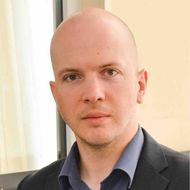
Тимофеев Алексей Владимирович
Московский институт электроники и математики им. А.Н. Тихонова
Профессиональные интересы
Должности
- Ведущий научный сотрудник — Московский институт электроники и математики им. А.Н. Тихонова, Международная лаборатория суперкомпьютерного атомистического моделирования и многомасштабного анализа
- Доцент — Московский институт электроники и математики им. А.Н. Тихонова, Департамент прикладной математики
Био
- · Начал работать в НИУ ВШЭ в 2012 году.
- · Научно-педагогический стаж: 20 лет.
Образование
- 2012 · Кандидат физико-математических наук: Московский физико-технический институт, специальность 01.04.08 «Физика плазмы», тема диссертации: Аномальный разогрев движения пылевых частиц в плазме газового разряда
- 2011 · Аспирантура: Московский физико-технический институт, факультет: МБФ, специальность «физика плазмы»
- 2010 · Магистратура: Московский физико-технический институт, специальность «Прикладные математика и физика», квалификация «Магистр прикладных математики и физики»
Опыт работы
- · 2005: C года занимался исследовательской деятельностью (теоретические исследование, компьютерное моделирование) в области физики плазмы в ОИВТ РАН. Начал с должности стажёра-исследователя, был младшим научным сотрудником (м.н.с.), н.с., с.н.с., зам.зав.лаб, и сейчас работаю в должности заведующего лабораторией теории неидеальной плазмы и заместителем директора по научной работе
- · 2010: С года преподаю в МФТИ
- · 2012: С года преподаю в МИЭМ ВШЭ
Награды и поощрения
- · Награды 1) медаль РАН для студентов высших учебных заведений России за лучшие научные работы в 2010г. 2) Премия «Новая генерация» 2008г. для молодых учёных в области энергетики и смежных наук от РАО "ЕЭС России" 3) Почетная грамота НИУ ВШЭ за лучшую русскоязычную научную работу 2022г. 4) Почетная грамота Минобрнауки 2024г.
- · Надбавка за публикацию в журнале из Списка А (и приравненном к нему научном издании) (2025–2026, 2024–2025, 2023–2024)
- · Надбавка за публикацию в международном рецензируемом научном издании (2022–2023, 2021–2022, 2020–2021, 2019–2020, 2018–2019)
- · Надбавка за статью в зарубежном рецензируемом журнале (2013–2015)
- · Лучший преподаватель — 2018
- · Победитель Конкурса лучших русскоязычных научных и научно-популярных работ работников НИУ ВШЭ – 2022
Гранты и проекты
- — · Гранты РНФ 1) проект №14-50-00124 - участие, 2) проект №20-71-10127 - руководство
Конференции (5)
Показать все
- · 2019: XXXIV International Conference on Interaction of Intense Energy Fluxes with Matter ELBRUS-2019 (Elbrus, Kabardino-Balkaria, Russia). Доклад: Velocities relaxation in LJ system
- · 2018: Supercomputing frontiers Europe (Варшава). Доклад: Elbrus processors performance for fast Fourier transform and computational materials science codes
- · 2017: 8th International Conference on the Physics of Dusty Plasmas (Прага). Доклад: Configuration and Kolmogorov-Sinai entropy in dusty plasma model
- · 2016: Cуперкомпьютерное моделирование в естественных и инженерных науках (Supercomputer Simulations in Science and Engineering) (Москва). Доклад: Parametric resonance and energy transfer in dusty plasma: theory and simulation
- · 2015: DIAGNOSTICS AND SIMULATION OF DUSTY PLASMAS (Киль). Доклад: Divergence of dust particle trajectories and entropy in dusty plasma model
Идентификаторы исследователя
- ORCID:
0000-0003-1156-893X - ResearcherID:
Z-4670-2019 - SPIN РИНЦ:
1035-8880 - Google Scholar: https://scholar.google.ru/citations?user=uuFrrdUAAAAJ&hl=en
- Scopus AuthorID:
57201423009
Публикации (53)
Influence of ion shadowing effect on average inter-particle distance in dusty plasma crystals
2019 · ARTICLE · en
Average distance between particles of dust in dusty plasma crystals is sensitive to the temperature of neutral atoms in a glow discharge plasma. In some experiments a significant decrease of average inter-particle distance after cooling to low temperatures is observed: the distance at 100 K is up to 4 times less than at 300 K. In this work dusty plasma system is studied by the method of numerical solving of Newton equations which is similar to the method of molecular dynamics. It is shown that the model of dusty plasma interaction including only the Debye potential and electrostatic parabolic trap may be not enough to explain this effect. Adding ion shadowing potential to this model increases the difference between the values of inter-particle distance at 100 and 300 K by 2–3 times. Comparison of theoretical results with experiments of other groups shows that some of the experimental points may be well approximated by this model.
Параметрический резонанс и перенос энергии в пылевой плазме
2018 · ARTICLE · ru
Для описания динамики монослоя пылевых частиц в плазме газового разряда построена модель, позволяющая аналитическое и численное исследование плазменно-пылевой системы. Механизм переноса энергии между горизонтальным и вертикальным движением пылевых частиц, основанный на параметрическом резонансе, описан с помощью расширенного уравнения Матьё. При исследовании данного уравнения получены области резонанса и показатели роста энергии пылевых частиц. На основе анализа полученных данных уточнены условия возникновения параметрического резонанса в плазменно-пылевой сис- теме и описана начальная стадия процесса переноса энергии. Показано, что в разогреве системы принимает участие широкий спектр колебаний пылевых частиц, выделены частоты, вносящие в него наибольший вклад.
Resonant Energy Transfer Between Degrees of Freedom in a Dusty Plasma System
2018 · ARTICLE · en
Dust particles under certain conditions can acquire kinetic energy of the order of 10 eV and higher, far above the temperature of gas and temperatures of ions and electrons in the discharge. Furthermore, significant difference of mean horizontal and vertical energy is observed. Such difference can be explained by the energy transfer between degrees of freedom of a dusty plasma system. The proposed mechanism of energy transfer between vertical and horizontal motion is based on parametric resonance. A system of equations describing dust particles' motion with account of dust particle charge fluctuations and features of the discharge near-electrode layer is formulated. Molecular dynamics simulations of dust particles' system are performed. Dependences of magnitude of transferred energy and horizontal energy growth rate on system parameters are obtained.
Deploying Elbrus VLIW CPU ecosystem for materials science calculations: performance and problems
2018 · CHAPTER · en
Modern Elbrus-4S and Elbrus-8S processors show floating point performance comparable to the popular Intel processors in the field of high-performance computing. Tasks oriented to take advantage of the VLIW architecture show even greater efficiency on Elbrus processors. In this paper the efficiency of the most popular materials science codes in the field of classical molecular dynamics and quantum-mechanical calculations is considered. A comparative analysis of the performance of these codes on Elbrus processor and other modern processors is carried out
Dependence of average inter-particle distance upon the temperature of neutrals in dusty plasma crystals
2018 · ARTICLE · en
It is often suggested that inter-particle distance in stable dusty plasma structures decreases with cooling as a square root of neutral gas temperature. Deviations from this dependence (up to the increase at cryogenic temperatures) found in the experimental results for the pressures range 0.1–8.0 mbar and for the currents range 0.1–1.0 mA are given. Inter-particle distance dependences on the charge of particles, parameter of the trap and the screening length in surrounding plasma are obtained for different conditions from molecular dynamics simulations. They are well approximated by power functions in the mentioned range of parameters. It is found that under certain assumptions thermophoretical force is responsible for inter-particle distance increase at cryogenic temperatures
Early Performance Evaluation of the Hybrid Cluster with Torus Interconnect Aimed at Molecular-Dynamics Simulations
2018 · CHAPTER · en
Nowadays, the wide spectrum of Intel Xeon processors is available. The new Zen CPU architecture developed by AMD has extended the number of options for x86_64 HPC hardware. Moreover, Nvidia has released a custom 64-bit Denver architecture based on the ARM instruction set. This large number of options makes the optimal CPU choice for perspective HPC systems not a straightforward procedure. Such a co-design procedure should follow the requests from the end-users community. Modern computational materials science studies are among the major consumers of HPC resources worldwide. The VASP code is perhaps the most popular tool for these research. In this work, we discuss the benchmark metric and results based on a VASP test model that give us the possibility to compare different hardware and to distinguish the best options with respect to energy-to-solution criterion.
Optimization of MPI-Process Mapping for Clusters with Angara Interconnect
2018 · ARTICLE · en
An algorithm of MPI processes mapping optimization is adapted for supercomputers with interconnect Angara. The mapping algorithm is based on partitioning of parallel program communication pattern. It is performed in such a way that the processes between which the most intensive exchanges take place are tied to the nodes/processors with the highest bandwidth. The algorithm finds a near-optimal distribution of its processes for processor cores to minimize the total execution time of exchanges between MPI processes. The analysis of results of optimized placement of processes using proposed method on small supercomputers is shown. The analysis of the dependence of the MPI program execution time on supercomputer parameters and task parameters is performed. A theoretical model is proposed for estimation of effect of mapping optimization on the execution time for several types of supercomputer topologies. The prospect of using implemented optimization library for large-scale supercomputers with the interconnect Angara is discussed.
Performance of Elbrus Processors for Computational Materials Science Codes and Fast Fourier Transform
2018 · CHAPTER · en
Modern Elbrus-4S and Elbrus-8S processors provide a level of floating-point performance close to that of widespread x86_64 CPUs that are predominantly used in high-performance computing (HPC). The uniqueness of the software ecosystem of Elbrus processors requires special attention in the case of their deployment for execution of mainstream computational codes. In this paper, we consider the performance of one widely used code for computational materials science (VASP), as well as FFT libraries. The results for the Elbrus processors are embedded into the context of performance of modern x86_64 CPUs.
Пылевая плазма в тлеющем разряде гелия в диапазоне температур 5-300 К
2017 · ARTICLE · ru
Экспериментально исследованы плазменно-пылевые структуры в тлеющем разряде гелия в диапазоне температур 5–300 К. Описана экспериментальная установка, предоставляющая возможность непрерыв- ного изменения температурного режима, и параметры эксперимента. Представлена методика обработки экспериментальных данных. Проведено измерение межчастичных расстояний в диапазоне температур 9–295 К и их сравнение с величиной радиуса Дебая. Указаны диапазоны параметров эксперимента, при которых формируются плазменно-пылевые структуры и проявляются различные формы их поведе- ния (вращение, колебания структур, образование вертикальных линейных цепочек и т. д.). Обсуждается применимость потенциала Юкавы к описанию структурных свойств пылевой плазмы в условиях экспе- римента.
Dusty plasma in a glow discharge in helium in temperature range of 5–300 K
2017 · ARTICLE · en
Экспериментально исследованы плазменно-пылевые структуры в тлеющем разряде гелия в диапазоне температур 5–300 К. Описана экспериментальная установка, предоставляющая возможность непрерыв- ного изменения температурного режима. Представлена методика обработки экспериментальных дан- ных. Проведено измерение межчастичных расстояний в диапазоне температур 9–295 К и их сравнение с величиной радиуса Дебая. Указаны диапазоны параметров эксперимента, при которых формируются плазменно-пылевые структуры и проявляются различные формы их поведения (вращение, колебания структур, образование вертикальных линейных цепочек и т. д.). Обсуждается применимость потенциала Юкавы к описанию структурных свойств пылевой плазмы в условиях эксперимента
Курсы (5)
-
Высокопроизводительные вычисления · 3 раза
2025/2026, 2024/2025, 2023/2024 · Магистратура / Маго-лего · рус
-
Математические методы и компьютерные технологии (семинар наставника)
2024/2025 · семинар наставника · рус
-
01.04.02. Прикладная математика и информатика · 3 раза
2023/2024, 2022/2023, 2021/2022 · Магистратура · рус
-
Высокоуровневое и имитационное моделирование цифровых систем
2022/2023 · Маго-лего · рус
-
Научно - исследовательский семинар
2021/2022 · Бакалавриат · рус