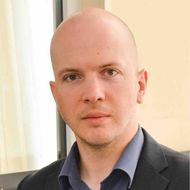
Тимофеев Алексей Владимирович
Московский институт электроники и математики им. А.Н. Тихонова
Профессиональные интересы
Должности
- Ведущий научный сотрудник — Московский институт электроники и математики им. А.Н. Тихонова, Международная лаборатория суперкомпьютерного атомистического моделирования и многомасштабного анализа
- Доцент — Московский институт электроники и математики им. А.Н. Тихонова, Департамент прикладной математики
Био
- · Начал работать в НИУ ВШЭ в 2012 году.
- · Научно-педагогический стаж: 20 лет.
Образование
- 2012 · Кандидат физико-математических наук: Московский физико-технический институт, специальность 01.04.08 «Физика плазмы», тема диссертации: Аномальный разогрев движения пылевых частиц в плазме газового разряда
- 2011 · Аспирантура: Московский физико-технический институт, факультет: МБФ, специальность «физика плазмы»
- 2010 · Магистратура: Московский физико-технический институт, специальность «Прикладные математика и физика», квалификация «Магистр прикладных математики и физики»
Опыт работы
- · 2005: C года занимался исследовательской деятельностью (теоретические исследование, компьютерное моделирование) в области физики плазмы в ОИВТ РАН. Начал с должности стажёра-исследователя, был младшим научным сотрудником (м.н.с.), н.с., с.н.с., зам.зав.лаб, и сейчас работаю в должности заведующего лабораторией теории неидеальной плазмы и заместителем директора по научной работе
- · 2010: С года преподаю в МФТИ
- · 2012: С года преподаю в МИЭМ ВШЭ
Награды и поощрения
- · Награды 1) медаль РАН для студентов высших учебных заведений России за лучшие научные работы в 2010г. 2) Премия «Новая генерация» 2008г. для молодых учёных в области энергетики и смежных наук от РАО "ЕЭС России" 3) Почетная грамота НИУ ВШЭ за лучшую русскоязычную научную работу 2022г. 4) Почетная грамота Минобрнауки 2024г.
- · Надбавка за публикацию в журнале из Списка А (и приравненном к нему научном издании) (2025–2026, 2024–2025, 2023–2024)
- · Надбавка за публикацию в международном рецензируемом научном издании (2022–2023, 2021–2022, 2020–2021, 2019–2020, 2018–2019)
- · Надбавка за статью в зарубежном рецензируемом журнале (2013–2015)
- · Лучший преподаватель — 2018
- · Победитель Конкурса лучших русскоязычных научных и научно-популярных работ работников НИУ ВШЭ – 2022
Гранты и проекты
- — · Гранты РНФ 1) проект №14-50-00124 - участие, 2) проект №20-71-10127 - руководство
Конференции (5)
Показать все
- · 2019: XXXIV International Conference on Interaction of Intense Energy Fluxes with Matter ELBRUS-2019 (Elbrus, Kabardino-Balkaria, Russia). Доклад: Velocities relaxation in LJ system
- · 2018: Supercomputing frontiers Europe (Варшава). Доклад: Elbrus processors performance for fast Fourier transform and computational materials science codes
- · 2017: 8th International Conference on the Physics of Dusty Plasmas (Прага). Доклад: Configuration and Kolmogorov-Sinai entropy in dusty plasma model
- · 2016: Cуперкомпьютерное моделирование в естественных и инженерных науках (Supercomputer Simulations in Science and Engineering) (Москва). Доклад: Parametric resonance and energy transfer in dusty plasma: theory and simulation
- · 2015: DIAGNOSTICS AND SIMULATION OF DUSTY PLASMAS (Киль). Доклад: Divergence of dust particle trajectories and entropy in dusty plasma model
Идентификаторы исследователя
- ORCID:
0000-0003-1156-893X - ResearcherID:
Z-4670-2019 - SPIN РИНЦ:
1035-8880 - Google Scholar: https://scholar.google.ru/citations?user=uuFrrdUAAAAJ&hl=en
- Scopus AuthorID:
57201423009
Публикации (53)
OpenDust: A fast GPU-accelerated code for the calculation of forces acting on microparticles in a plasma flow
2023 · ARTICLE · en
We present the first open-source, GPU-based code for complex plasmas. The code, OpenDust, pursues to provide researchers, both experimenters and theorists, a user-friendly and high-performance tool for self-consistent calculation forces, acting on microparticles, and microparticles' charges in a plasma flow. OpenDust performance originates from a highly-optimized Cuda back-end and performs self-consistent calculations of plasma flow around microparticles in seconds. This code outperforms all available codes for self-consistent complex plasma simulation. Moreover, OpenDust can also be used for the simulation of larger systems of dust microparticles, which was previously unavailable. OpenDust interface is written in Python, which provides ease-of-use and simple installation from the Conda repository.
Spatial localization of high-frequency particle oscillations in a complex plasma monolayer
2023 · ARTICLE · en
We study the spatial distribution of dynamical properties in a strongly coupled confined experimental dust monolayer with a dense central region and a rarefied periphery. We show that the dust particle oscillations spectrum shifts into the low-frequency range from the center of the structure toward its periphery. Correspondingly, the high-frequency particle oscillations are localized in the central region of the system. This effect is quantitatively described within the framework of the model system of trapped screened Coulomb charges. Such spatial localization has a significant effect on the spatial distribution of dynamical parameters, such as the amplitude of particle oscillations and the coupling parameter. The obtained results might be useful for the theory of crystal formation, instabilities and phase transitions in complex (dusty) plasmas, colloidal suspensions, and Coulomb crystals.
Self-sustained non-equilibrium co-existence of fluid and solid states in a strongly coupled complex plasma system
2022 · ARTICLE · en
A complex (dusty) plasma system is well known as a paradigmatic model for studying the kinetics of solid-liquid phase transitions in inactive condensed matter. At the same time, under certain conditions a complex plasma system can also display characteristics of an active medium with the micron-sized particles converting energy of the ambient environment into motility and thereby becoming active. We present a detailed analysis of the experimental complex plasmas system that shows evidence of a non-equilibrium stationary coexistence between a cold crystalline and a hot fluid state in the structure due to the conversion of plasma energy into the motion energy of microparticles in the central region of the system. The plasma mediated non-reciprocal interaction between the dust particles is the underlying mechanism for the enormous heating of the central subsystem, and it acts as a micro-scale energy source that keeps the central subsystem in the molten state. Accurate multiscale simulations of the system based on combined molecular dynamics and particle-in-cell approaches show that strong structural nonuniformity of the system under the action of electostatic trap makes development of instabilities a local process. We present both experimental tests conducted with a complex plasmas system in a DC glow discharge plasma and a detailed theoretical analysis.
Performance Analysis of GPU-Based Code for Complex Plasma Simulation
2022 · CHAPTER · en
According to the TOP-500 supercomputer ranking [27], since 2017, the share of supercomputers which have NVIDIA V100 and A100 graphics accelerators has been continuously growing, reaching 80% by November 2021 from the total number of supercomputers with accelerators and co-processors. This paper presents the results of an assessment of energy and economic efficiency, as well as the performance study of using V100 and A100 graphics accelerators in the framework of complex plasma physics. In addition, the use of several accelerators for one calculation is considered. In order to quantify the effectiveness of the considered devices, we use the following metrics: calculation time, resource efficiency, economical efficiency, power efficiency.
PIConGPU on Desmos Supercomputer: GPU Acceleration, Scalability and Storage Bottleneck
2022 · CHAPTER · en
Particle-in-Cell models are among the most demanding computational problems that require appropriate supercomputing hardware. In this paper we consider the solution of generic PIC problems on the Desmos supercomputer equipped with novel AMD MI50 GPUs and Angara interconnect. The open-source PIConGPU code is used. The acceleration limits and bottlenecks for this type of calculations are considered.
Towards OpenUCX and GPUDirect Technology Support for the Angara Interconnect
2022 · CHAPTER · en
Modern supercomputers consist of thousands of GPUs interconnected by high-speed HPC fabric. Angara interconnect supports Remote Direct Memory Access (RDMA) semantic, hence making it promising fabric solution for GPU-based supercomputers with a large amount of high-bandwidth RAM. Within this work we extend Angara interconnect low-level API allowing one transparently register (pin) GPU and user-space memory, hence enabling zero-copy approach and GPUDirect RDMA support. We present our implementation of Angara interconnect support within the state-of-the-art OpenUCX and OpenMPI communication stack. Memcpy function optimized for AMD GPU achieves up to 10×10× bandwidth speed up for medium to large MPI messages. With the help of Rendezvous protocol and our memory registration API the MPI bandwidth is increased by up to 68×
Performance of Supercomputers Based on Angara Interconnect and Novel AMD CPUs/GPUs
2022 · CHAPTER · en
A low-latency high bandwidth interconnect that makes a unified system from a collection of nodes is a heart of any modern su- percomputer. At the moment, Infiniband is the main commercially avail- able type of interconnect without any other real competition world-wide. Proprietary interconnects are known to stand behind effcient supercomputer systems. Since 2016, the supercomputer centre of JIHT RAS deploys systems based on the Angara interconnect developed in Moscow by JSC NICEVT. In this paper, we present the performance analysis for two recently upgraded supercomputers in JIHT RAS that are based on two types of Angara interconnect and modern AMD Epyc CPUs and AMD Instinct MI50 GPUs. The general properties of Angara intercon- nects are described and compared with Infiniband FDR. The details of HPL benchmark runs on both systems are analysed.
Исследование спектральных свойств пространственно-неоднородной системы частиц Юкавы в параболическом конфайнменте
2022 · ARTICLE · ru
Исследуются динамические свойства системы из конечного числа одноименно заряженных частиц, взаимодействующих по экранированному кулоновскому потенциалу в поле параболической ловушки. Методом анализа нормальных мод в квазигармоническом приближении получено пространственное распределение амплитуд колебаний частиц в системе: высокочастотные колебания локализуются в ее центральной области. Это приводит к тому, что в разных областях структуры спектры колебаний частиц различны. Для обобщения этого результата на широкий температурный диапазон проведено численное моделирование систем из конечного числа заряженных частиц в ловушке методом классической молекулярной динамики. Показана пространственная неоднородность спектров тепловых колебаний частиц: происходит смещение спектра в низкочастотную область при увеличении расстояния от рассматриваемой подсистемы до центра структуры. Различные методы расчета амплитуды тепловых колебаний частиц - как в рамках квазигармонического приближения, так и методом молекулярной динамики - подтверждают неоднородность радиального профиля амплитуды: на периферии системы амплитуда тепловых колебаний частиц имеет более высокое значение, чем в центре структуры. Показано, что в локальном приближении динамические свойства подсистем структур из конечного числа заряженных частиц в ловушке при определенных условиях существенно отличаются от динамических свойств систем заряженных частиц близкой плотности в периодических граничных условиях. Результаты настоящего исследования могут быть полезны при описании динамических свойств лабораторных плазменно-пылевых и коллоидных систем.
Nonhomogeneity of phase state in a dusty plasma monolayer with nonreciprocal particle interactions
2021 · ARTICLE · en
A monolayer—quasi-two-dimensional finite system—of Yukawa particles in a harmonic trap is under consideration. The effect of monolayer nonhomogeneity on dynamic properties and melting is studied. The results for two models of particle interactions are compared. The first model includes the reciprocal Yukawa potential and electrostatic harmonic trap. The second model additionally employs the point charge approximation of plasma wakes. It accounts for the nonreciprocity of interactions and anomalous heating of particle motion observed in dusty plasma experiments. It is demonstrated that in the point-wake model, both out-of-plane and in-plane kinetic energies of particles are radially dependent. This effect transforms the spatial distribution of dynamic characteristics in the monolayer. We show that the nonuniformity of monolayer properties might lead to several nonuniform melting scenarios and several scenarios of phase coexistence in the system. In the monolayer without nonreciprocal interactions, molten periphery coexists with a solid core. In the monolayer with plasma wakes, the opposite scenario is observed due to the joint effect of nonreciprocity and structural nonuniformity in the system. A perspective method to determine the position of the phase boundary is proposed.
Effect of Structural Inhomogeneity and Nonreciprocal Effects in the Interaction of Macroparticles on the Dynamic Properties of a Dusty Plasma Monolayer
2021 · ARTICLE · en
The dynamic properties of a quasi-two-dimensional dusty plasma structure consisting of negatively charged dust particles have been studied. The interaction between the particles is described taking into account the asymmetry of the distribution of the electrostatic potential around them. Asymmetry is caused by the presence of an ion flow in the region of existence of a monolayer and leads to the violation of reciprocity of the effective interactions between particles and the violation of Newton’s third law for them. It has been demonstrated that the spatial distribution of the dynamic properties of the dusty plasma monolayer such as the kinetic energy of the particles, the amplitude of their thermal vibrations, and the nonideality parameter in the system are generally nonuniform. The central region of the ordered monolayer can be both more and less nonideal than the boundary region, depending on the parameters of the dusty plasma. This unique effect occurs because a hybrid mode can appear in the center of the monolayer without the melting of the system. The characters of inhomogeneity of the dynamic properties of the Yukawa and dusty plasma monolayers are significantly different. The results obtained allow a qualitatively new view on the dynamic properties of strongly nonideal dusty plasma systems.
Курсы (5)
-
Высокопроизводительные вычисления · 3 раза
2025/2026, 2024/2025, 2023/2024 · Магистратура / Маго-лего · рус
-
Математические методы и компьютерные технологии (семинар наставника)
2024/2025 · семинар наставника · рус
-
01.04.02. Прикладная математика и информатика · 3 раза
2023/2024, 2022/2023, 2021/2022 · Магистратура · рус
-
Высокоуровневое и имитационное моделирование цифровых систем
2022/2023 · Маго-лего · рус
-
Научно - исследовательский семинар
2021/2022 · Бакалавриат · рус