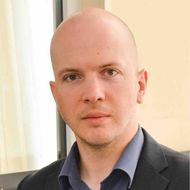
Тимофеев Алексей Владимирович
Московский институт электроники и математики им. А.Н. Тихонова
Профессиональные интересы
Должности
- Ведущий научный сотрудник — Московский институт электроники и математики им. А.Н. Тихонова, Международная лаборатория суперкомпьютерного атомистического моделирования и многомасштабного анализа
- Доцент — Московский институт электроники и математики им. А.Н. Тихонова, Департамент прикладной математики
Био
- · Начал работать в НИУ ВШЭ в 2012 году.
- · Научно-педагогический стаж: 20 лет.
Образование
- 2012 · Кандидат физико-математических наук: Московский физико-технический институт, специальность 01.04.08 «Физика плазмы», тема диссертации: Аномальный разогрев движения пылевых частиц в плазме газового разряда
- 2011 · Аспирантура: Московский физико-технический институт, факультет: МБФ, специальность «физика плазмы»
- 2010 · Магистратура: Московский физико-технический институт, специальность «Прикладные математика и физика», квалификация «Магистр прикладных математики и физики»
Опыт работы
- · 2005: C года занимался исследовательской деятельностью (теоретические исследование, компьютерное моделирование) в области физики плазмы в ОИВТ РАН. Начал с должности стажёра-исследователя, был младшим научным сотрудником (м.н.с.), н.с., с.н.с., зам.зав.лаб, и сейчас работаю в должности заведующего лабораторией теории неидеальной плазмы и заместителем директора по научной работе
- · 2010: С года преподаю в МФТИ
- · 2012: С года преподаю в МИЭМ ВШЭ
Награды и поощрения
- · Награды 1) медаль РАН для студентов высших учебных заведений России за лучшие научные работы в 2010г. 2) Премия «Новая генерация» 2008г. для молодых учёных в области энергетики и смежных наук от РАО "ЕЭС России" 3) Почетная грамота НИУ ВШЭ за лучшую русскоязычную научную работу 2022г. 4) Почетная грамота Минобрнауки 2024г.
- · Надбавка за публикацию в журнале из Списка А (и приравненном к нему научном издании) (2025–2026, 2024–2025, 2023–2024)
- · Надбавка за публикацию в международном рецензируемом научном издании (2022–2023, 2021–2022, 2020–2021, 2019–2020, 2018–2019)
- · Надбавка за статью в зарубежном рецензируемом журнале (2013–2015)
- · Лучший преподаватель — 2018
- · Победитель Конкурса лучших русскоязычных научных и научно-популярных работ работников НИУ ВШЭ – 2022
Гранты и проекты
- — · Гранты РНФ 1) проект №14-50-00124 - участие, 2) проект №20-71-10127 - руководство
Конференции (5)
Показать все
- · 2019: XXXIV International Conference on Interaction of Intense Energy Fluxes with Matter ELBRUS-2019 (Elbrus, Kabardino-Balkaria, Russia). Доклад: Velocities relaxation in LJ system
- · 2018: Supercomputing frontiers Europe (Варшава). Доклад: Elbrus processors performance for fast Fourier transform and computational materials science codes
- · 2017: 8th International Conference on the Physics of Dusty Plasmas (Прага). Доклад: Configuration and Kolmogorov-Sinai entropy in dusty plasma model
- · 2016: Cуперкомпьютерное моделирование в естественных и инженерных науках (Supercomputer Simulations in Science and Engineering) (Москва). Доклад: Parametric resonance and energy transfer in dusty plasma: theory and simulation
- · 2015: DIAGNOSTICS AND SIMULATION OF DUSTY PLASMAS (Киль). Доклад: Divergence of dust particle trajectories and entropy in dusty plasma model
Идентификаторы исследователя
- ORCID:
0000-0003-1156-893X - ResearcherID:
Z-4670-2019 - SPIN РИНЦ:
1035-8880 - Google Scholar: https://scholar.google.ru/citations?user=uuFrrdUAAAAJ&hl=en
- Scopus AuthorID:
57201423009
Публикации (53)
Towards performance analysis of GPU-aware MPI over Angara interconnect
2026 · ARTICLE · en
One of the most important aspects of supercomputer development in the post-Moore era is the interconnect technologies that allow one to unite a multitude of processing elements into a well-synchronized computing system. Novel types of supercomputer interconnect require careful benchmarking and compliance with the requirements of modern hardware trends. GPU-based heterogeneous computing is one of the most important current avenues for building high performance computing systems, and the support of GPU-aware MPI technology is a requirement for any competitive interconnect. In this paper, we describe a UCX API based GPU-aware MPI implementation for the Angara interconnect. Performance analysis for peer-to-peer, MPI_Bcast and MPI_Reduce operations is presented, as well as for the rocHPL benchmark and for a typical biomolecular model within the LAMMPS molecular dynamics code. The deployment of the Desmos supercomputer equipped with both Angara and InfiniBand FDR allows us to make an accurate comparison of these two types of interconnect using the latter as a reference.
Performance Analysis of Computational Devices in Quantum Chemistry Tasks
2026 · CHAPTER · en
Modern supercomputer systems play a crucial role in scientific and engineering research. To ensure their effectiveness, these fields require reliable methods for evaluating supercomputer performance. Although benchmarking is a fundamental tool, current ranking systems often inadequately represent real-world performance in high-performance computing (HPC) applications. As a result, employing actual scientific software packages provides a more accurate and relevant assessment of system capabilities. In this study, we analyze the performance of supercomputer components for quantum physics and chemistry problems, with a focus on density-functional theory (DFT). Using the quantum chemistry packages Quantum ESPRESSO and CP2K, we identify key performance bottlenecks and discuss their relationship to underlying hardware characteristics.
Deviation of a system of nonreciprocally coupled harmonic oscillators from a conservative system
2025 · ARTICLE · en
Discrete systems of coupled linear mechanical oscillators with nonreciprocal interaction are a model for a variety of physical systems. In general, the presence of nonreciprocal interactions renders their dynamics nonconservative, but under certain conditions it remains conservative. In this paper we show which thermodynamic properties induced by nonreciprocity can be observed in conservative systems and which are specific to nonconservative systems. To this end, we formulate a criterion for identifying conservative systems and construct a measure to quantify the deviation from conservativity.
Tracing of GPU-Aware MPI Applications: First Benchmarks for the Angara Interconnect
2025 · CHAPTER · en
The efficiency of data transfer is one of the most important issues of supercomputer development in the post-Moore era. The rise of heterogeneous computing systems introduces such complicated patterns of data transfers as, for instance, the GPU-aware MPI technology. The practical deployment of this technology in applications requires the development of the dedicated system software as well as the analysis tools for tracing the runtime behavior of the corresponding applied algorithms. In this work we present the UCX API for GPU-aware MPI implementation over Angara interconnect and analyze the execution patterns of the rocHPL benchmark using the Score-P infrastructure. This analysis allows us to make a comparison of the GPU-aware MPI implementation for the Angara interconnect with the InfiniBand implementation.
Efficiency of Machine Learning Tasks on HPC Devices
2025 · CHAPTER · en
Accurate benchmarking is critical for selecting computing architectures optimized for machine learning (ML) tasks. Conventional benchmarks such as High-Performance Linpack (HPL) and High Performance Conjugate Gradients (HPCG) often fail to capture the diversity and complexity of modern ML workloads. This study investigates the correlation between hardware parameters (e.g., processor architecture, cache size, frequency) and ML performance across various devices, including CPUs and accelerators. By studying a wide range of ML tasks, we identify key performance bottlenecks and explore whether a correlation-based approach can guide the selection of optimal hardware for an entire class of ML tasks. Our findings offer practical recommendations for future computing architectures and advance the efficient use of high-performance computing for diverse ML applications.
Atomistic mechanism of activation controlled liquid metal corrosion at the Fe-Pb interface
2025 · ARTICLE · en
A bcc iron bicrystal in contact with liquid lead is studied in molecular dynamics simulations to describe the atomistic mechanism of liquid metal corrosion in the activation controlled case. In this process, the main structural features involved are Fe grain boundaries and Fe-Pb interfaces. The atomistic model considered reveals that the interplay of atomic processes such as surface self-diffusion of Fe and dissolution of Fe into Pb determines the mechanism and kinetics law of liquid metal corrosion. Analysis of the proposed mechanism explains the dependence between the kinetics of liquid metal corrosion and the grain size of the specimen.
Influence of wake field inhomogeneity on the vibrational spectra of two dust particles in a plasma with an ion flow
2024 · ARTICLE · en
A charged colloidal (dust) particle immersed in a plasma with an ion flow creates a disturbed region behind it, known as a wake. The paper considers a system of two charged and strongly coupled microparticles aligned along the ion flow in a weakly ionized plasma (e.g., in the plasma sheath of a ground-based RF discharge) and confined vertically by an external electric field. Using the OpenDust code, a fully self-consistent numerical simulation of the dynamics of dust particles and the ionic component is carried out. It is demonstrated that the inhomogeneity of the wake field from the upstream particle can significantly change the spectrum of vertical (longitudinal) vibrations of both particles in the system and has a negligible effect on their horizontal (transverse) vibrations. In particular, a relationship exists between horizontal and vertical particle oscillations, manifested as an additional mode of vertical vibrations of particles corresponding to the doubled frequency of their relative horizontal vibrations. In accordance with the model of nonreciprocally coupled stochastically driven oscillators, analytical expressions are derived for the vibrational spectra of particles taking into account the spatial variations in particle charges caused by inhomogeneities in the surrounding plasma. The proposed theory improves the experimental method of spectral response to stochastic processes, enabling the measurement of effective forces, particle friction coefficients, and temperatures of their heat sources, as well as the horizontal charge gradient of the lower particle oscillating in the wake field of the upper one.
Оценка производительности суперкомпьютера “cHARISMa” и его компонент для квантовой химии на примере пакетов в CP2K и Quantum Espresso
2024 · CHAPTER · ru
Оценка производительности суперкомпьютера “cHARISMa” и его компонент для квантовой химии на примере пакетов в CP2K и Quantum Espresso
Оценочное тестирование эффективности вычислительных узлов суперкомпьютера cHARISMa для задач глубокого обучения
2024 · CHAPTER · ru
Оценочное тестирование эффективности вычислительных узлов суперкомпьютера cHARISMa для задач глубокого обучения
Point Defect Model for the kinetics of oxide film growth on the surface of T91 steel in contact with lead–bismuth eutectic
2023 · ARTICLE · en
Point Defect Model (PDM) has been successfully employed for aqueous solutions to describe the rate of surface corrosion of structural materials. In this work, the adaptation of PDM for the case of lead–bismuth coolant is developed. The necessary modifications in the set of electrochemical reactions and in the model of electrostatic potential distribution in the oxide film are made. Parameters of the proposed model, PDM_PB, are optimized using the experimental data for T91 grade steel. The obtained adaptation of PDM shows applicability to the case of lead and lead–bismuth coolants which is of critical importance for the next-generation fast-neutron reactors.
Курсы (5)
-
Высокопроизводительные вычисления · 3 раза
2025/2026, 2024/2025, 2023/2024 · Магистратура / Маго-лего · рус
-
Математические методы и компьютерные технологии (семинар наставника)
2024/2025 · семинар наставника · рус
-
01.04.02. Прикладная математика и информатика · 3 раза
2023/2024, 2022/2023, 2021/2022 · Магистратура · рус
-
Высокоуровневое и имитационное моделирование цифровых систем
2022/2023 · Маго-лего · рус
-
Научно - исследовательский семинар
2021/2022 · Бакалавриат · рус