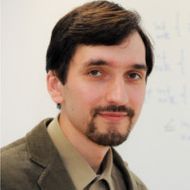
Беломестный Денис Витальевич
Факультет компьютерных наук
Профессиональные интересы
Должности
- Ведущий научный сотрудник — Факультет компьютерных наук, Институт искусственного интеллекта и цифровых наук, Международная лаборатория стохастических алгоритмов и анализа многомерных данных
Био
- · Начал работать в НИУ ВШЭ в 2014 году.
- · Научно-педагогический стаж: 11 лет.
Образование
- 2002 · Кандидат физико-математических наук: Московский государственный университет им. М.В. Ломоносова
- 1998 · Специалитет: Московский государственный университет им. М.В. Ломоносова, специальность «Прикладная математика», квалификация «Математик»
Опыт работы
- · 1998 - 2002: МГУ им. Ломоносова
- · 2002 - 2003: Институт прикладной математики университета Бонн
- · 2003 - 2011: Институт Вейерштрасса прикладного анализа и стохастики (Берлин)
- · 2011: н.вр. Университет Дуйсбург-Эссен
Награды и поощрения
- · Надбавка за академическую работу (2020–2021, 2019–2020)
- · Надбавка за статью в зарубежном рецензируемом научном издании (2016–2018)
- · Лучший преподаватель — 2019
Конференции (2)
Показать все
- · 2015: 10th IMACS Seminar on Monte Carlo Methode (Линц). Доклад: Multilevel Monte Carlo for weak approximation schemes
- · 2015: Workshop on "Nonparametric and high-dimensional statistics", Heidelberg (Хайдельберг). Доклад: Low-rank diffusion covariance matrix estimation under presence of jumps
Идентификаторы исследователя
- ORCID:
0000-0002-9482-6430 - ResearcherID:
A-4393-2014 - Google Scholar: https://scholar.google.com/citations?user=WFjIBlcAAAAJ&hl=ru
- Scopus AuthorID:
15069577900
Публикации (68)
Decompounding under general mixing distributions
2026 · ARTICLE · en
This study focuses on statistical inference for compound models of the form \(X=\xi_1+\ldots+\xi_N\), where \(N\) is a random variable denoting the count of summands, which are independent and identically distributed (i.i.d.) random variables \(\xi_1, \xi_2, \ldots\). The paper addresses the problem of reconstructing the distribution of \(\xi\) from observed samples of \(X\)'s distribution, a process referred to as decompounding, with the assumption that \(N\)'s distribution is known. This work diverges from the conventional scope by not limiting \(N\)'s distribution to the Poisson type, thus embracing a broader context. We propose a nonparametric estimate for the density of \(\xi,\) derive its rates of convergence and prove that these rates are minimax optimal for suitable classes of distributions for \(\xi\) and \(N\). Finally, we illustrate the numerical performance of the algorithm on simulated examples.
Specification Tests for Jump-Diffusion Models Based on the Characteristic Function
2026 · ARTICLE · en
Goodness-of-fit tests are suggested for several popular jump-diffusion processes. The suggested test statistics utilise the marginal characteristic function of the model and its L2-type discrepancy from an empirical counterpart. Model parameters are estimated either by minimising the aforementioned L2-type discrepancy or by maximum likelihood. A hybrid estimation method that uses moment estimation is also proposed as a standalone method, or to calculate initial points. A fairly extensive Monte Carlo study is conducted in which the performance of a bootstrap version of the new tests is measured against classical specification procedures involving the empirical distribution function. The study concludes with empirical applications on a number of financial assets, as well as an analysis on the impact of misspecification on option pricing.
UVIP: Model-Free Approach to Evaluate Reinforcement Learning Algorithms
2026 · ARTICLE · en
Policy evaluation is an important instrument for the comparison of different algorithms in Reinforcement Learning (RL). However, even a precise knowledge of the value function Vπ corresponding to a policy π does not provide reliable information on how far the policy π is from the optimal one. We present a novel model-free upper value iteration procedure (UVIP) that allows us to estimate the suboptimality gap V(x) − Vπ (x) from above and to construct confidence intervals for V. Our approach relies on upper bounds to the solution of the Bellman optimality equation via the martingale approach. We provide theoretical guarantees for UVIP under general assumptions and illustrate its performance on a number of benchmark RL problems. Communicated by Alexander Vladimirovich Gasnikov
Statistical Inference for Conservation Law McKean–Vlasov SDEs via Deep Neural Networks
2025 в печати · ARTICLE · en
This work addresses statistical inference for a flux function based on observations from a nonlinear McKean–Vlasov process governed by a conservation law. This process is nonlinear, as the drift term of the corresponding SDE depends on the process’s law through its distribution function. We propose a novel maximum likelihood estimation (MLE)–type approach for estimating the invariant density and the flux function of this nonlinear process using deep neural networks. We derive convergence rates for the relative entropy distance between the estimated invariant density and its true value, which imply rates for the flux function estimate. Technically, our paper is among the first in the literature to address MLE of noncompact densities using deep neural networks. We also consider observations from the corresponding particle system and present some numerical results.
Nonasymptotic Analysis of Stochastic Gradient Descent with the Richardson–Romberg Extrapolation
2025 · CHAPTER · en
Weighted mesh algorithms for general Markov decision processes: Convergence and tractability
2025 · ARTICLE · en
We introduce a mesh-type approach for tackling discrete-time, finite-horizon Markov Decision Processes (MDPs) characterized by state and action spaces that are general, encompassing both finite and infinite (yet suitably regular) subsets of Euclidean space. In particular, for bounded state and action spaces, our algorithm achieves a computational complexity that is tractable in the sense of Novak & Woźniakowski [12], and is polynomial in the time horizon. For unbounded state space the algorithm is “semi-tractable” in the sense that the complexity is proportional to ε −c with some dimension independent c ≥ 2, for achieving an accuracy ε, and polynomial in the time horizon with degree linear in the underlying dimension. As such the proposed approach has some flavor of the randomization method by Rust [14] which deals with infinite horizon MDPs and uniform sampling in compact state space. However, the present approach is essentially different due to the finite horizon and a simulation procedure due to general transition distributions, and more general in the sense that it encompasses unbounded state space. To demonstrate the effectiveness of our algorithm, we provide illustrations based on Linear-Quadratic Gaussian (LQG) control problems.
Rates of convergence for density estimation with generative adversarial networks
2024 · ARTICLE · en
In this work we undertake a thorough study of the non-asymptotic properties of the vanilla generative adversarial networks (GANs). We prove an oracle inequality for the Jensen-Shannon (JS) divergence between the underlying density 𝗉∗ and the GAN estimate with a significantly better statistical error term compared to the previously known results. The advantage of our bound becomes clear in application to nonparametric density estimation. We show that the JS-divergence between the GAN estimate and 𝗉∗ decays as fast as (logn/n)2β/(2β+d), where n is the sample size and β determines the smoothness of 𝗉∗. This rate of convergence coincides (up to logarithmic factors) with minimax optimal for the considered class of densities.
Theoretical guarantees for neural control variates in MCMC
2024 · ARTICLE · en
In this paper, we propose a variance reduction approach for Markov chains based on additive control variates and the minimization of an appropriate estimate for the asymptotic variance. We focus on the particular case when control variates are represented as deep neural networks. We derive the optimal convergence rate of the asymptotic variance under various ergodicity assumptions on the underlying Markov chain. The proposed approach relies upon recent results on the stochastic errors of variance reduction algorithms and function approximation theory.
Decompounding under general mixing distributions
2024 · PREPRINT · en
This study focuses on statistical inference for compound models of the form \(X=\xi_1+\ldots+\xi_N\), where \(N\) is a random variable denoting the count of summands, which are independent and identically distributed (i.i.d.) random variables \(\xi_1, \xi_2, \ldots\). The paper addresses the problem of reconstructing the distribution of \(\xi\) from observed samples of \(X\)'s distribution, a process referred to as decompounding, with the assumption that \(N\)'s distribution is known. This work diverges from the conventional scope by not limiting \(N\)'s distribution to the Poisson type, thus embracing a broader context. We propose a nonparametric estimate for the density of \(\xi,\) derive its rates of convergence and prove that these rates are minimax optimal for suitable classes of distributions for \(\xi\) and \(N\). Finally, we illustrate the numerical performance of the algorithm on simulated examples.
Nonparametric statistical inference for compound models
2024 · ARTICLE · en
This paper deals with the statistical inference in compound models, which are defined as a sum of i.i.d. random variables \(\xi_1+...+\xi_N\), where the number of summands, \(N\), is a random variable independent of \(\xi_1, \xi_2,...\) Using the novel technique based on the superposition of the Mellin and Laplace transforms, we construct a nonparametric estimator for the distribution of \(N\), assuming that the distribution of \(\xi\) is known explicitly. Unlike most papers on this topic, we consider the general setting, where the distribution of \(N\) is not necessarily of Poisson type.
Курсы (0)
Нет курсов.