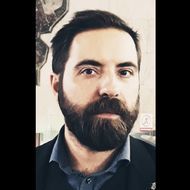
Милонас Янис
Факультет креативных индустрий
Профессиональные интересы
Должности
- Доцент — Факультет креативных индустрий, Институт медиа
Био
- · Начал работать в НИУ ВШЭ в 2014 году.
- · Научно-педагогический стаж: 11 лет.
Образование
- 2009 · PhD: Копенгагенский университет, тема диссертации: ‘Discursive struggles on the “war on terror”; politics, crisis and Representation’
- 2002 · Магистратура: Университет Бата, специальность «Прикладная социальная психология», квалификация «Магистр наук»
- 2001 · Бакалавриат: Университет Янины, специальность «философия»
Опыт работы
- · Associate Professor at the Media, Communications and Design Department, National, Research University, Higher School of Economics, in Moscow, Russia
- · Post-doctoral researcher at the Media and Communications Department, Lund University in Sweden (2010-2012)
- · Lecturer at the Film, Media, Cognition and Communication Department and at the Cultural Studies Department, Copenhagen University in Denmark (2007-2014)
Награды и поощрения
- · Лучший преподаватель — 2024–2025
Идентификаторы исследователя
- ORCID:
0000-0001-5496-6714 - ResearcherID:
L-8836-2015 - SPIN РИНЦ:
3563-0375 - Google Scholar: https://scholar.google.ru/citations?view_op=list_works&hl=ru&gmla=AJsN-F4QpzzGRFjDnzIL6ydS2tkTEFhlu0If4k33hy_1U4FonyeJGwDne2PsEiO_YlECKY29wZFesZWZjBXgv1KhWky9LZS1L3lAo22u7sFouLk8jwrgHHQ&user=-2PZiNYAAAAJ
- Scopus AuthorID:
54791223700
Публикации (50)
Reinventing political subjectivities; studying critical documentaries on the "war on terror"
2012 · ARTICLE · en
This paper casts a look on media aspects of the anti-war-on-terror struggle in western countries. A peculiar warfare, the “war on terror” that officially begun in 2001, is a low-density global warfare, fought in different internal and external fronts . Within a liberal, increasingly post-political social terrain, where social affairs are objects of expert management lacking public accountability and legitimacy, the role, status and the identity of the contemporary citizen is in decline. New media “affordances” offer critical possibilities for challenging hegemonic political discourses, and addressing political alternatives for a broad range of social problems; a re-invention of citizenship through the construct of a new (collective) political subject is central in the reinvention of democracy today. Discourse analysis, drawing reflexively on post-structuralist discourse theory and critical discourse analysis, is deployed in the study of counter-war-on-terror discourses in different documentaries critical to the “war on terror”. Analysis looks at different constructions of “us” and “them” in the context of counter-hegemonic discourses today. Identity is central in the engagement, participation and orientation of citizens today. Identity is central in organising a collective centre and in initiating subjectivity to fragmented liberal, postmodern individuals.
Discourses of counter-Islamic-threat mobilisation in post 9/11 documentaries
2012 · ARTICLE · en
This article critically studies documentaries focusing on the “Islamic terrorist threat”, produced in the US and in Western Europe. the particular films relate to the discourses of the growing far-right political movements in liberal democracies. The article analyzes the communicational tactics deployed by the film-makers for counter-terrorist mobilization of “Westerners”. The films’ producers objectify the terrorist threat as exceptional and ontological, in order to recon-figure the identity of the “West”. The analysis focuses on representations of the West’s threatening Other through the reflexive use of critical discourse analysis and poststructuralist, discourse theory. Counter-threat strategies, varying from warfare to biopolitical control, are articulated as social demands and as individualized tasks of inclusion to the ideological space of the West and the sovereign space of western nation-states. The critical study of the particular documentaries aims at highlighting the regressive and character of the passionate discourses of far right media, in relation to the political crisis that liberal democracies across the world are facing.
Amateur Creation and Entrepreneurialism: A Critical Study of Artistic Production in Post-Fordist Structures
2012 · ARTICLE · en
Based on an interview with a hip-hop artist from Eastern Poland, this article critically assesses amateur art pro-duction proliferating throughout the globe today through individuals’ creative usages of new ICTs and new media affor-dances. The post-Fordist material and ideological context of contemporary social life is the main focus point of the article’s critique. Scarcity, dispossession, and entrepreneurship are the main analytical concepts used to develop a critical analysis and explanation of mainstream realities of amateur artistic production today. Within a context defined by precarious work conditions and prospects, material scarcity, and consumerist aspirations, media and technological potentialities are strategi-cally used by the amateur artist-entrepreneur a) as resources where creativity is put to work for potential socio-economic elevation and inclusion in the global industrial artistic scene (in the case of private ICT), b) as “free” resources, appropriated for entrepreneurial aspirations (in the case of “free“ digital material circulating online, particularly through peer to peer net-works), c) as channels for self promotion and networking (in the case of web 2.0 structures). What is often less apparent to the amateur artists, though, concerns the exploitative capacities of corporate Internet to dispossess amateur work and online social relations for the purposes of capital accumulation and reproduction. Unless critiqued, “free culture” -generated by new ICTs and new media- is assimilated by the material and ideological power of late capitalism and is “put to work” for the (re)production of late capitalism. The article concludes by suggesting the critical challenging of the mainstream artistic identity and the critical use and appropriation of new media/ ICT’s potentialities.
Intellectual Property rights and their discontents
2012 · CHAPTER · pl
‘Piracy’ is a negative term describing the worldwide popular practice of sharing, distributing and consuming cultural and intellectual goods without authorisation. The ‘affordances’ (Jenkins, 2006) of new digital information and communication (ICT) technologies offer users many possibilities to develop a ‘free culture’ (Lessig, 2004) surpassing ‘free’ market laws, contrary to ICT industries’ planning. ICT industries largely perceive piracy as a major problem with many dimensions: economic, social, cultural, moral, political. Intellectual property rights’ (IPR) policies attempt to counter piracy on a worldwide scale.
Media and the economic crisis of the EU: the “culturalization” of a systemic crisis and Bild-Zeitung's framing of Greece
2012 · ARTICLE · en
This article critically studies the hegemonic discursive construction of the EU’s current (2012) economic crisis, as it is articulated by political and economic elites and by mass media. The study focuses on the political economy of the particular crisis and through the critical concept of reification, the study emphasizes the hegemonic naturalization of the economic crisis by the “free market” economistic ideology. The article problematizes the positioning of Greece as the “crisis epicentre” in Europe, understanding Greece as a scapegoat and as a laboratory where political strategies of capitalist restructuring of the EU are performed. Through the frame analysis of Bild-zeitung’s headlines on the coverage of crisis-struck Greece, the article discusses a) the “culturalization” of the crisis and the diversion from a structural public debate on the global economic crisis b) the disciplinary function of crisis’ publicity, related to social control and the production of new, neoliberal social subjectivities c) the alienating effect of the culturalist crisis discourses to transnational publics, resulting to the misrecognition of the ideological and structural reasons of the given crisis, the misrecognition of the effects of the crisis and crisis-politics in people’s lives, the misrecognition of popular socio-political struggles in countries worse struck by crisis politics, and the eclipse of transnational solidarity and identification to the common issues that European people in particular are facing.
Civic culture and informal media uses: Poles and Greeks discussing “free culture”
2012 · ARTICLE · en
Accumulation, control and contingency; a critical review of intellectual property rights' piracy
2011 · ARTICLE · en
This article problematizes piracy a) as a hegemonic discourse and technology of control, aiming to securitize late capitalist accumulation; b) as a practice developed by the multitudes that is compatible to post – Fordist mode of production and to neoliberal norms; and, c) as resistance to dominant mode of late capitalist production, distribution and consumption of immaterial goods. The article addresses and criticizes capitalism’s ‘organic’ and strategic colonization of fundamental social commons, such as culture, intellectual goods, as well as human creativity and communication, by looking at the ideological, institutional and material processes that reproduce the capitalist ‘machine’. This paper concludes by considering the possibility of overcoming the capitalist approach to commons, through the politicization of IPR as well as through the connection of the problem they pose to broader social perspectives, confronting capitalism — in its post political disguises — politically.
Politics of identity in reactionary, post 9/11 documentary
2011 · CHAPTER · en
Research hypothesis derives from ‘post modern’ theoretical assumptions (Mouffe, 2004: 87) on the contingent and political nature of the social and plays with two important variables; on one hand the ‘democratic deficit’ as the political stagnation of post 1990’s liberal democracies with the universalisation of neoliberal dogmas, a degrade of democracy to a cumulative procedure, and the diminishing of politics into a form of public management (Bauman, 2006); on the other hand, a chronologically simultaneous ‘rise of the particulars’ (Beck, 1999; Laclau, 2000) and the latter’s potential for new politics.
Logics of the Right and the Left in aspects of the public contestation of the ‘war on terror
2009 · CHAPTER · en
In this paper, my main purpose is to outline the theoretical horizon I propose to analytically approach the public constitution and contestation of the ‘war on terror’ as traced in media texts in Western Liberal states. Building upon a post structuralist ontology influenced by Laclau & Mouffe, (1985), this study aims to problematise the potentialities of counter hegemonic, democratic politics in an era marked by political stagnation.
Crisis, conspiracy and rights: Imaginaries of terrorism in documentary film
2007 · ARTICLE · en
The dispersed character of terrorism as a practice became more coherent to the Western realm through the operationalisation of counter terrorist discourses. The media played a major role in that in the sense that they provided public ‘visibility’ upon the potentiality of terrorist threat. What this essay would like to discuss is the way such representations of threat negotiate a number of issues evolving around ‘civil rights’; discrimination, intensification of surveillance or militarization legitimacy of a state of emergency; and how public discourses of broader issues of ‘rights’ are contextualized in the aftermath of a terrorist attack. The case study is a documentary produced shortly after a terrorist event that embraces the question ‘why bomb London?’ regarding the London public transport attacks of 7/7/2005. The analytical paradigm used is based on Critical Discourse Analysis which provides a structure that can respond to different questions of ‘how’ the signification of emergency is constructed.
Курсы (6)
-
Critical and Cultural Theory · 4 раза
2025/2026, 2024/2025, 2023/2024, 2022/2023 · Магистратура / Маго-лего · Анг
-
Research Seminar · 5 раза
2025/2026, 2024/2025, 2023/2024, 2022/2023, 2021/2022 · Магистратура · Анг
-
Mentor's Seminar "Media Theories and Student's Individual Trajectory" · 3 раза
2025/2026, 2024/2025, 2023/2024 · Магистратура · Анг
-
Критические и культурные теории
2024/2025 · Маго-лего · рус
-
Critical and Cultural Theory: Reading Seminar
2021/2022 · Магистратура · Анг
-
Media, Culture and Society
2021/2022 · Бакалавриат · Анг