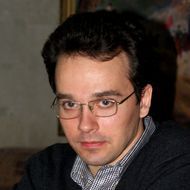
Стегайлов Владимир Владимирович
Московский институт электроники и математики им. А.Н. Тихонова
Профессиональные интересы
Должности
- Ведущий научный сотрудник — Московский институт электроники и математики им. А.Н. Тихонова, Международная лаборатория суперкомпьютерного атомистического моделирования и многомасштабного анализа
- Профессор — Московский институт электроники и математики им. А.Н. Тихонова, Департамент прикладной математики
Био
- · Начал работать в НИУ ВШЭ в 2014 году.
- · Научно-педагогический стаж: 32 года.
Образование
- 2012 · Доктор физико-математических наук: МФТИ, специальность 01.04.07 «Физика конденсированного состояния», тема диссертации: Классические и квантовые атомистические модели отклика конденсированных сред на интенсивные энергетические воздействия
- 2009 · Ученое звание: Доцент
- 2005 · Кандидат наук: специальность 01.04.02 «Теоретическая физика», тема диссертации: Теоретические основы исследования методом молекулярной динамики фазовых превращений в метастабильных кристаллах и жидкостях
- 2004 · Магистратура: Московский физико-технический институт, специальность «Прикладные математика и физика», квалификация «Магистр»
Опыт работы
- · 1997: лаборант ЛЯП ОИЯИ (во время летних каникул) с
- · 1999: работаю в научной группе проф. Г.Э. Нормана
- · 2001-2004: стажер-исследователь ИТЭС ОИВТ РАН
- · 2004-2005: младший научный сотрудник ИТЭС ОИВТ РАН
- · 2005-2007: научный сотрудник ИТЭС ОИВТ РАН
- · 2007-2009: старший научный сотрудник ОИВТ РАН
- · 2009-2013: заведующий лабораторией ОИВТ РАН
- · 2013-н.в.: заведующий отделом ОИВТ РАН
- · 2006-н.в.: преподаю в МФТИ, профессор, зам. зав. базовой кафедрой физики высокотемпературных процессов в ОИВТ РАН
- · 2010-2012: ежегодные рабочие визиты в Аргоннскую Национальную Лабораторию (США)
- · 2010-2013: ведущий научный сотрудник Центра фундаментальных и прикладных исследований ВНИИА им. Н.Л.Духова
Награды и поощрения
- · Победитель конкурса на право получения средств для государственной поддержки ведущих научных школ Российской Федерации (Конкурс НШ-2018), проект "Развитие суперкомпьютерных методов многомасштабного и атомистического моделирования для расчета свойств рабочих тел, материалов и процессов, ориентированных на новые энергетические технологии" (НШ-5922.2018.8) Премия Президента Российской Федерации молодым ученым в области науки и инноваций за 2015 год Работа "Атомистическое моделирование взаимодействия электролитов с графитовыми наноструктурами в перспективных суперконденсаторах" (А.В. Ланкин, В.В. Стегайлов) получила 2-ю премию по секции "Математическое моделирование нанотехнологий" Международного конкурса научных работ молодых ученых в области нанотехнологий, который проходил в рамках Роснанофорума 6-8 октября 2009 г. Работа "Деформационные и прочностные свойства наноструктурных конструкционных материалов" (В.В. Стегайлов, А.Ю. Куксин, А.В. Янилкин, С.В. Стариков) получила 1-ю премию по секции "Математическое моделирование нанотехнологий" Международного конкурса научных работ молодых ученых в области нанотехнологий, который проходил в рамках Роснанофорума 3-5 декабря 2008 г. Работа "Моделирование свойств наноматериалов методами классической и квантовой молекулярной динамики" (В.В. Стегайлов, Г.Э. Норман, А.Ю. Куксин, А.В. Янилкин, С.В. Стариков, П.А. Жиляев, В.В. Писарев, О.В. Сергеев) победила в конкурсе проектов в сфере высокопроизводительных вычислений, организованного совместно Российской корпорацией нанотехнологий (РОСНАНО) и корпорацией Intel в 2008 г. Премия РАО "ЕЭС России" и Российской академии наук в области энергетики и смежных наук "Новая генерация-2005" для молодых ученых Медаль РАН с премией для студентов вузов России за 2004 г. Стипендия Фонда "Династия" и Международного центра фундаментальной физики в Москве (для студентов 2003-2004 гг., для аспирантов 2005-2006 гг.) Гранты Москвы "Аспирант-2005", "Студент - 2004, 2003, 2002" Гранты "Соросовский студент - 2001, 2000, 1999"
- · Надбавка за публикацию в журнале из Списка А (и приравненном к нему научном издании) (2025–2026, 2024–2025, 2023–2024)
- · Надбавка за публикацию в международном рецензируемом научном издании (2022–2023, 2021–2022, 2020–2021, 2017–2019)
- · Надбавка за статью в зарубежном рецензируемом журнале (2014–2016)
- · Лучший преподаватель — 2018
Гранты и проекты
- — · на соискание учёной степени кандидата наук
Конференции (12)
Показать все
- · 2023: Суперкомпьютерные дни в России 2023 (Москва). Доклад: GPU-accelerated matrix exponent for solving 1D time-dependent Schrödinger equation
- · 2020: Математическое Моделирование и Суперкомпьютерные Технологии (Нижний Новгород). Доклад: Алгоритм Матричного Умножения для Нескольких GPU, Объединенных Высокоскоростными Каналами Связи
- · 2017: 60 Научная конференция МФТИ (Долгопрудный). Доклад: Учет квантовых эффектов ядер в жидкости методом интегралов по траекториям
- · 2017: XXXII International Conference on Interaction of Intense Energy Fluxes with Matter ELBRUS-2017 (Эльбрус). Доклад: Finite-difference time-domain simulation of the interaction between ultrashort laser pulses and metal nanoparticles
- · 2016: 11th International High Power Laser Ablation & Directed Energy Symposium (HPLA-2016) (Санта-Фе). Доклад: Pressure, ionization and effective ion-ion interaction in electronically excited warm dense metals
- · 2016: ARM Research Summit 2016 (Cambridge). Доклад: Practical Efficiency of ARM CPUs: Classical Molecular Dynamics Benchmark
- · 2015: 13th International Conference "Parallel Computing Technologies" (PaCT-2015) (Петрозаводск). Доклад: HPC Hardware Efficiency for Quantum and Classical Molecular Dynamics
- · 2015: ISC High Performance (International Supercomputing Conference ISC-2015) (Франкфурт). Доклад: Coupling efficiency of models, algorithms and hardware: atomistic simulation perspective
- · 2015: Национальный Суперкомпьютерный Форум (НСКФ-2016) (Переславль-Залесский). Доклад: Перспективы экзафлопсных вычислений в разработке новых технологий энергетики
- · 2015: Russian Supercomputing Days (Москва). Доклад: Перспективы экзафлопсных вычислений в разработке новых технологий энергетики
- · 2015: Russian Supercomputing Days (Москва). Доклад: Эффективность процессоров ARM для расчетов классической молекулярной динамики
- · 2015: Национальный Суперкомпьютерный Форум (НСКФ-2016) (Переславль-Залесский). Доклад: Перспективы процессоров ARM для решения практических задач: тесты молекулярной динамики
Идентификаторы исследователя
- ORCID:
0000-0002-5349-3991 - ResearcherID:
C-4756-2013 - SPIN РИНЦ:
2526-2291 - Google Scholar: https://scholar.google.com/citations?user=GhMJ1J0AAAAJ&hl=en
- Scopus AuthorID:
6603823822
Публикации (92)
Quantum nuclear effects in water using centroid molecular dynamics
2018 · ARTICLE · en
The quantum nuclear effects are studied in water using centroid molecular dynamics (CMD) method. The aim is the calibration of CMD implementation in LAMMPS. The calculated intramolecular energy, atoms gyration radii and radial distribution functions are shown in comparison with previous works. The work is assumed to be the step toward to solution of the discrepancy between the simulation results and the experimental data of liquid n-alkane properties in our previous works.
Graphics-processing-unit-accelerated finite-difference time-domain simulation of the interaction between ultrashort laser pulses and metal nanoparticles
2018 · ARTICLE · en
Metal nanoparticles (NPs) serve as important tools for many modern technologies. However, the proper microscopic models of the interaction between ultrashort laser pulses and metal NPs are currently not very well developed in many cases. One part of the problem is the description of the warm dense matter that is formed in NPs after intense irradiation. Another part of the problem is the description of the electromagnetic waves around NPs. Description of wave propagation requires the solution of Maxwell's equations and the finite-difference time-domain (FDTD) method is the classic approach for solving them. There are many commercial and free implementations of FDTD, including the open source software that supports graphics processing unit (GPU) acceleration. In this report we present the results on the FDTD calculations for different cases of the interaction between ultrashort laser pulses and metal nanoparticles. Following our previous results, we analyze the efficiency of the GPU acceleration of the FDTD algorithm.
Domain-Decomposition Parallelization for Molecular Dynamics Algorithm with Short-Ranged Potentials on Epiphany Architecture
2018 · ARTICLE · en
Many-core processor architecture is a promising paradigm for the development of modern supercomputers. In this paper, we consider the parallel implementation of the generic molecular dynamics algorithm for the many-core Epiphany architecture. This architecture implements a new type of many-core processor composed of 16 simple cores connected by a network on chip with mesh topology. New approaches to parallel programming are required to deploy this processor. We use LAMMPS running on one 64-bit ARMv8 Cortex-A53 CPU core for comparing the accuracy of the results of the presented variant of the molecular dynamics algorithm for Epiphany and its computational efficiency.
Pseudopotential for ab initio calculations of uranium compounds
2018 · ARTICLE · en
The density functional theory (DFT) is a research tool of the highest importance for electronic structure calculations. It is often the only affordable method for ab initio calculations of complex materials. The pseudopotential approach allows reducing the total number of electrons in the model that speeds up calculations. However, there is a lack of pseudopotentials for heavy elements suitable for condensed matter DFT models. In this work, we present a pseudopotential for uranium developed in the Goedecker–Teter–Hutter form. Its accuracy is illustrated using several molecular and solid-state calculations.
Hybrid Supercomputer Desmos with Torus Angara Interconnect: Efficiency Analysis and Optimization
2018 · CHAPTER · en
The paper describes the first experience of practical deployment of the hybrid supercomputer Desmos at the Joint Institute for High Temperatures of the Russian Academy of Sciences (JIHT RAS). We consider job scheduling statistics, energy efficiency, case studies of GPU acceleration efficiency and benchmarks of the distributed storage with a parallel file system.
Deploying Elbrus VLIW CPU ecosystem for materials science calculations: performance and problems
2018 · CHAPTER · en
Modern Elbrus-4S and Elbrus-8S processors show floating point performance comparable to the popular Intel processors in the field of high-performance computing. Tasks oriented to take advantage of the VLIW architecture show even greater efficiency on Elbrus processors. In this paper the efficiency of the most popular materials science codes in the field of classical molecular dynamics and quantum-mechanical calculations is considered. A comparative analysis of the performance of these codes on Elbrus processor and other modern processors is carried out
Early Performance Evaluation of the Hybrid Cluster with Torus Interconnect Aimed at Molecular-Dynamics Simulations
2018 · CHAPTER · en
Nowadays, the wide spectrum of Intel Xeon processors is available. The new Zen CPU architecture developed by AMD has extended the number of options for x86_64 HPC hardware. Moreover, Nvidia has released a custom 64-bit Denver architecture based on the ARM instruction set. This large number of options makes the optimal CPU choice for perspective HPC systems not a straightforward procedure. Such a co-design procedure should follow the requests from the end-users community. Modern computational materials science studies are among the major consumers of HPC resources worldwide. The VASP code is perhaps the most popular tool for these research. In this work, we discuss the benchmark metric and results based on a VASP test model that give us the possibility to compare different hardware and to distinguish the best options with respect to energy-to-solution criterion.
Performance of Elbrus Processors for Computational Materials Science Codes and Fast Fourier Transform
2018 · CHAPTER · en
Modern Elbrus-4S and Elbrus-8S processors provide a level of floating-point performance close to that of widespread x86_64 CPUs that are predominantly used in high-performance computing (HPC). The uniqueness of the software ecosystem of Elbrus processors requires special attention in the case of their deployment for execution of mainstream computational codes. In this paper, we consider the performance of one widely used code for computational materials science (VASP), as well as FFT libraries. The results for the Elbrus processors are embedded into the context of performance of modern x86_64 CPUs.
Classic Molecular Dynamics Algorithm For Many-Core Processor Architecture Epiphany: Performance And Efficiency
2018 · CHAPTER · en
One of the most important problems for the creation of exaflops supercomputer is the reduction in the energy consumption of hardware. In this paper, the many-core processor architecture Epiphany is considered as a promising energy-efficient technology. The review of programming methods for new hardware is conducted, the development and debugging of the algorithm of classical molecular dynamics for this processor is described. Using the prototype platform Parallella with the Epiphany chip, the performance and the energy efficiency of the hardware and software systems are examined. The results are compared with other relevant CPU and accelerators.
Efficiency Analysis of Intel and AMD x86_64 Architectures for Ab Initio Calculations: A Case Study of VASP
2017 · CHAPTER · en
Nowadays, the wide spectrum of Intel Xeon processors is available. The new Zen CPU architecture developed by AMD has extended the number of options for x86_64 HPC hardware. This large number of options makes the optimal CPU choice for HPC systems not a straightforward procedure. Such a co-design procedure should follow the requests from the end-users community. Modern computational materials science studies are among the major consumers of HPC resources worldwide. The VASP code is perhaps the most popular tool for these research. In this work, we discuss the benchmark metric and results based on a VASP test model that give us the possibility to compare different CPUs and to select best options with respect to time-to-solution and energy-to-solution criteria.
Курсы (5)
-
Высокопроизводительные вычисления · 3 раза
2025/2026, 2024/2025, 2023/2024 · Магистратура / Маго-лего · рус
-
Математические методы и компьютерные технологии (семинар наставника)
2025/2026 · семинар наставника · рус
-
01.04.02. Прикладная математика и информатика · 3 раза
2023/2024, 2022/2023, 2021/2022 · Магистратура · рус
-
Высокоуровневое и имитационное моделирование цифровых систем
2022/2023 · Маго-лего · рус
-
01.04.04. Прикладная математика
2022/2023 · семинар наставника · рус