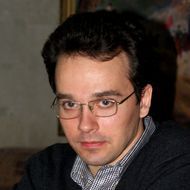
Стегайлов Владимир Владимирович
Московский институт электроники и математики им. А.Н. Тихонова
Профессиональные интересы
Должности
- Ведущий научный сотрудник — Московский институт электроники и математики им. А.Н. Тихонова, Международная лаборатория суперкомпьютерного атомистического моделирования и многомасштабного анализа
- Профессор — Московский институт электроники и математики им. А.Н. Тихонова, Департамент прикладной математики
Био
- · Начал работать в НИУ ВШЭ в 2014 году.
- · Научно-педагогический стаж: 32 года.
Образование
- 2012 · Доктор физико-математических наук: МФТИ, специальность 01.04.07 «Физика конденсированного состояния», тема диссертации: Классические и квантовые атомистические модели отклика конденсированных сред на интенсивные энергетические воздействия
- 2009 · Ученое звание: Доцент
- 2005 · Кандидат наук: специальность 01.04.02 «Теоретическая физика», тема диссертации: Теоретические основы исследования методом молекулярной динамики фазовых превращений в метастабильных кристаллах и жидкостях
- 2004 · Магистратура: Московский физико-технический институт, специальность «Прикладные математика и физика», квалификация «Магистр»
Опыт работы
- · 1997: лаборант ЛЯП ОИЯИ (во время летних каникул) с
- · 1999: работаю в научной группе проф. Г.Э. Нормана
- · 2001-2004: стажер-исследователь ИТЭС ОИВТ РАН
- · 2004-2005: младший научный сотрудник ИТЭС ОИВТ РАН
- · 2005-2007: научный сотрудник ИТЭС ОИВТ РАН
- · 2007-2009: старший научный сотрудник ОИВТ РАН
- · 2009-2013: заведующий лабораторией ОИВТ РАН
- · 2013-н.в.: заведующий отделом ОИВТ РАН
- · 2006-н.в.: преподаю в МФТИ, профессор, зам. зав. базовой кафедрой физики высокотемпературных процессов в ОИВТ РАН
- · 2010-2012: ежегодные рабочие визиты в Аргоннскую Национальную Лабораторию (США)
- · 2010-2013: ведущий научный сотрудник Центра фундаментальных и прикладных исследований ВНИИА им. Н.Л.Духова
Награды и поощрения
- · Победитель конкурса на право получения средств для государственной поддержки ведущих научных школ Российской Федерации (Конкурс НШ-2018), проект "Развитие суперкомпьютерных методов многомасштабного и атомистического моделирования для расчета свойств рабочих тел, материалов и процессов, ориентированных на новые энергетические технологии" (НШ-5922.2018.8) Премия Президента Российской Федерации молодым ученым в области науки и инноваций за 2015 год Работа "Атомистическое моделирование взаимодействия электролитов с графитовыми наноструктурами в перспективных суперконденсаторах" (А.В. Ланкин, В.В. Стегайлов) получила 2-ю премию по секции "Математическое моделирование нанотехнологий" Международного конкурса научных работ молодых ученых в области нанотехнологий, который проходил в рамках Роснанофорума 6-8 октября 2009 г. Работа "Деформационные и прочностные свойства наноструктурных конструкционных материалов" (В.В. Стегайлов, А.Ю. Куксин, А.В. Янилкин, С.В. Стариков) получила 1-ю премию по секции "Математическое моделирование нанотехнологий" Международного конкурса научных работ молодых ученых в области нанотехнологий, который проходил в рамках Роснанофорума 3-5 декабря 2008 г. Работа "Моделирование свойств наноматериалов методами классической и квантовой молекулярной динамики" (В.В. Стегайлов, Г.Э. Норман, А.Ю. Куксин, А.В. Янилкин, С.В. Стариков, П.А. Жиляев, В.В. Писарев, О.В. Сергеев) победила в конкурсе проектов в сфере высокопроизводительных вычислений, организованного совместно Российской корпорацией нанотехнологий (РОСНАНО) и корпорацией Intel в 2008 г. Премия РАО "ЕЭС России" и Российской академии наук в области энергетики и смежных наук "Новая генерация-2005" для молодых ученых Медаль РАН с премией для студентов вузов России за 2004 г. Стипендия Фонда "Династия" и Международного центра фундаментальной физики в Москве (для студентов 2003-2004 гг., для аспирантов 2005-2006 гг.) Гранты Москвы "Аспирант-2005", "Студент - 2004, 2003, 2002" Гранты "Соросовский студент - 2001, 2000, 1999"
- · Надбавка за публикацию в журнале из Списка А (и приравненном к нему научном издании) (2025–2026, 2024–2025, 2023–2024)
- · Надбавка за публикацию в международном рецензируемом научном издании (2022–2023, 2021–2022, 2020–2021, 2017–2019)
- · Надбавка за статью в зарубежном рецензируемом журнале (2014–2016)
- · Лучший преподаватель — 2018
Гранты и проекты
- — · на соискание учёной степени кандидата наук
Конференции (12)
Показать все
- · 2023: Суперкомпьютерные дни в России 2023 (Москва). Доклад: GPU-accelerated matrix exponent for solving 1D time-dependent Schrödinger equation
- · 2020: Математическое Моделирование и Суперкомпьютерные Технологии (Нижний Новгород). Доклад: Алгоритм Матричного Умножения для Нескольких GPU, Объединенных Высокоскоростными Каналами Связи
- · 2017: 60 Научная конференция МФТИ (Долгопрудный). Доклад: Учет квантовых эффектов ядер в жидкости методом интегралов по траекториям
- · 2017: XXXII International Conference on Interaction of Intense Energy Fluxes with Matter ELBRUS-2017 (Эльбрус). Доклад: Finite-difference time-domain simulation of the interaction between ultrashort laser pulses and metal nanoparticles
- · 2016: 11th International High Power Laser Ablation & Directed Energy Symposium (HPLA-2016) (Санта-Фе). Доклад: Pressure, ionization and effective ion-ion interaction in electronically excited warm dense metals
- · 2016: ARM Research Summit 2016 (Cambridge). Доклад: Practical Efficiency of ARM CPUs: Classical Molecular Dynamics Benchmark
- · 2015: 13th International Conference "Parallel Computing Technologies" (PaCT-2015) (Петрозаводск). Доклад: HPC Hardware Efficiency for Quantum and Classical Molecular Dynamics
- · 2015: ISC High Performance (International Supercomputing Conference ISC-2015) (Франкфурт). Доклад: Coupling efficiency of models, algorithms and hardware: atomistic simulation perspective
- · 2015: Национальный Суперкомпьютерный Форум (НСКФ-2016) (Переславль-Залесский). Доклад: Перспективы экзафлопсных вычислений в разработке новых технологий энергетики
- · 2015: Russian Supercomputing Days (Москва). Доклад: Перспективы экзафлопсных вычислений в разработке новых технологий энергетики
- · 2015: Russian Supercomputing Days (Москва). Доклад: Эффективность процессоров ARM для расчетов классической молекулярной динамики
- · 2015: Национальный Суперкомпьютерный Форум (НСКФ-2016) (Переславль-Залесский). Доклад: Перспективы процессоров ARM для решения практических задач: тесты молекулярной динамики
Идентификаторы исследователя
- ORCID:
0000-0002-5349-3991 - ResearcherID:
C-4756-2013 - SPIN РИНЦ:
2526-2291 - Google Scholar: https://scholar.google.com/citations?user=GhMJ1J0AAAAJ&hl=en
- Scopus AuthorID:
6603823822
Публикации (92)
Molecular dynamics analysis of elastic properties and new phase formation during amorphous ices transformations
2022 · ARTICLE · en
Unlike conventional first-order phase transitions, the kinetics of amorphous-amorphous transitions has been much less studied. The ultrasonic experiments on the transformations between low-density and high-density amorphous ice induced by pressure or heating provided the pressure and temperature dependencies of elastic moduli. In this article, we make an attempt to build a microscopic picture of these experimentally studied transformations using the molecular dynamics method with the TIP4P/Ice water model. We study carefully the dependence of the results of elastic constants calculations on the deformation rates. The system size effects are considered as well. The comparison with the experimental data enriches our understanding of the transitions observed. Our modeling gives new information about the formation mechanisms of new phase clusters during the transition between low-density and high-density amorphous ices. We analyse the applicability of the term “nucleation” for these processes.
Tuning of a Matrix-Matrix Multiplication Algorithm for Several GPUs Connected by Fast Communication Links
2022 · CHAPTER · en
Frenkel pair formation energy for cubic Fe3O4 in DFT + U calculations
2022 · ARTICLE · en
The cubic phase of magnetite is stabilized above the Verwey transition temperature of about 120 K via a complex electron–phonon interaction that is still not very well understood. In this work using the DFT + U method we describe our attempt to calculate point defect formation energies for this cubic phase in the static approximation. The electronic structure calculations and atomic relaxation peculiarities are discussed in this context. Only the cubic phase model with a small band gap and charge disproportionation (Fe2+/Fe3+) gives an adequate point defect formation energies, not the semi-metallic model. The relaxation of the local defect atomic structure and the relaxation of the surrounding crystal matrix are analyzed. Point defects cause only local perturbations of atomic positions and charge-orbital order. After analysis of the supercell size effects for up to 448 atoms, we justify the use of small supercells with 56 atoms to make calculations for the cubic phase. The extensive experimental results of Dieckmann et al on defects in magnetite at high temperature are deployed for comparison of our DFT + U results on Frenkel pair formation energies.
Multi-GPU GEMM Algorithm Performance Analysis for Nvidia and AMD GPUs Connected by NVLink and PCIe
2022 · CHAPTER · en
Modern types of multi-GPU servers combine up to 8 A100 GPUs connected by NVLink 3.0 links through NVSwitch. This connectivity provides unprecedented capabilities for multi-GPU algorithms. In this work, we analyze the performance of matrix-matrix multiplication algorithm developed by us previously. Tuning principles and limits for maximum performance are discussed. Algorithm performance for much more affordable 4 AMD Radeon RX 6900 XT based server with PCI 4.0 working under ROCm HIP is described for comparison.
PIConGPU on Desmos Supercomputer: GPU Acceleration, Scalability and Storage Bottleneck
2022 · CHAPTER · en
Particle-in-Cell models are among the most demanding computational problems that require appropriate supercomputing hardware. In this paper we consider the solution of generic PIC problems on the Desmos supercomputer equipped with novel AMD MI50 GPUs and Angara interconnect. The open-source PIConGPU code is used. The acceleration limits and bottlenecks for this type of calculations are considered.
Performance of Supercomputers Based on Angara Interconnect and Novel AMD CPUs/GPUs
2022 · CHAPTER · en
A low-latency high bandwidth interconnect that makes a unified system from a collection of nodes is a heart of any modern su- percomputer. At the moment, Infiniband is the main commercially avail- able type of interconnect without any other real competition world-wide. Proprietary interconnects are known to stand behind effcient supercomputer systems. Since 2016, the supercomputer centre of JIHT RAS deploys systems based on the Angara interconnect developed in Moscow by JSC NICEVT. In this paper, we present the performance analysis for two recently upgraded supercomputers in JIHT RAS that are based on two types of Angara interconnect and modern AMD Epyc CPUs and AMD Instinct MI50 GPUs. The general properties of Angara intercon- nects are described and compared with Infiniband FDR. The details of HPL benchmark runs on both systems are analysed.
GPU-accelerated molecular dynamics: State-of-art software performance and porting from Nvidia CUDA to AMD HIP
2021 · ARTICLE · en
Classical molecular dynamics (MD) calculations represent a significant part of the utilization time of high-performance computing systems. As usual, the efficiency of such calculations is based on an interplay of software and hardware that are nowadays moving to hybrid GPU-based technologies. Several well-developed open-source MD codes focused on GPUs differ both in their data management capabilities and in performance. In this work, we analyze the performance of LAMMPS, GROMACS and OpenMM MD packages with different GPU backends on Nvidia Volta and AMD Vega20 GPUs. We consider the efficiency of solving two identical MD models (generic for material science and biomolecular studies) using different software and hardware combinations. We describe our experience in porting the CUDA backend of LAMMPS to ROCm HIP that shows considerable benefits for AMD GPUs comparatively to the OpenCL backend.
Dissociation of Exciton States in Warm Dense Hydrogen
2021 · ARTICLE · en
Переход из молекулярного в атомарное состояние в разогретом плотном флюиде водорода является предметом активных научных исследований в последние несколько десятилетий. Использование различных экспериментальных методик до сих пор не привело к получению надежных согласующихся между собой результатов. Несмотря на многочисленные попытки, теоретические методы пока не смогли объяснить имеющиеся расхождения в экспериментальных данных и микроскопическую природу механизма перехода флюида водорода в проводящее состояние. В работе [I. D. Fedorov, N. D. Orekhov, V. V. Stegailov, Phys. Rev. B 101, 100101(R) (2020)] была показана важность учета неравновесных неадиабатических процессов при анализе механизмов рассматриваемого перехода. В данной работе представлены результаты расчетов свойств экситонных состояний, образующихся в результате спонтанных вибронных возбуждений. Показано, что диссоциация подобных экситонов при высоких температурах может объяснить экспериментально детектируемые характеристики рассматриваемого перехода.
Energy Consumption of MD Calculations on Hybrid and CPU-Only Supercomputers with Air and Immersion Cooling
2020 · CHAPTER · en
The article presents the energy consumption and efficiency analysis based on the data from three small-size supercomputers installed in JIHT RAS. One system is the air-cooled hybrid supercomputer Desmos with AMD FirePro GPUs and two others are the air-cooled and liquid-cooled segments of the supercomputer Fisher based on AMD Epyc Naples CPUs. To collect data, we implement the same real-time analytics infrastructure on all three supercomputers. We consider classical molecular-dynamics problem as a benchmarking tool. Our results quantify the energy savings that are provided by the GPU-based calculations in compariso with CPU-only calculations and by liquid cooling in comparison with air-cooling. During strong scaling benchmarks, we detect an interesting minimum of energy consumption in the CPU-only case.
GPU Acceleration of Four-Site Water Models in LAMMPS
2020 · CHAPTER · en
In this work, a new algorithm was developed for calculating the fourpoint water model TIP4P on graphics accelerators. It was designed as a part of the flexible molecular dynamics modeling package LAMMPS in the library module “GPU”. In this paper we describe two approaches to implement the TIP4P model for GPU: 1) to divide the related computations between CPU and GPU; 2) to compute the interaction fully on the GPU. We verify the program, benchmark and profile it. The achieved speedup of interaction computation is about x7, acceleration of the entire calculation of about 55%.
Курсы (5)
-
Высокопроизводительные вычисления · 3 раза
2025/2026, 2024/2025, 2023/2024 · Магистратура / Маго-лего · рус
-
Математические методы и компьютерные технологии (семинар наставника)
2025/2026 · семинар наставника · рус
-
01.04.02. Прикладная математика и информатика · 3 раза
2023/2024, 2022/2023, 2021/2022 · Магистратура · рус
-
Высокоуровневое и имитационное моделирование цифровых систем
2022/2023 · Маго-лего · рус
-
01.04.04. Прикладная математика
2022/2023 · семинар наставника · рус