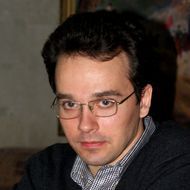
Стегайлов Владимир Владимирович
Московский институт электроники и математики им. А.Н. Тихонова
Профессиональные интересы
Должности
- Ведущий научный сотрудник — Московский институт электроники и математики им. А.Н. Тихонова, Международная лаборатория суперкомпьютерного атомистического моделирования и многомасштабного анализа
- Профессор — Московский институт электроники и математики им. А.Н. Тихонова, Департамент прикладной математики
Био
- · Начал работать в НИУ ВШЭ в 2014 году.
- · Научно-педагогический стаж: 32 года.
Образование
- 2012 · Доктор физико-математических наук: МФТИ, специальность 01.04.07 «Физика конденсированного состояния», тема диссертации: Классические и квантовые атомистические модели отклика конденсированных сред на интенсивные энергетические воздействия
- 2009 · Ученое звание: Доцент
- 2005 · Кандидат наук: специальность 01.04.02 «Теоретическая физика», тема диссертации: Теоретические основы исследования методом молекулярной динамики фазовых превращений в метастабильных кристаллах и жидкостях
- 2004 · Магистратура: Московский физико-технический институт, специальность «Прикладные математика и физика», квалификация «Магистр»
Опыт работы
- · 1997: лаборант ЛЯП ОИЯИ (во время летних каникул) с
- · 1999: работаю в научной группе проф. Г.Э. Нормана
- · 2001-2004: стажер-исследователь ИТЭС ОИВТ РАН
- · 2004-2005: младший научный сотрудник ИТЭС ОИВТ РАН
- · 2005-2007: научный сотрудник ИТЭС ОИВТ РАН
- · 2007-2009: старший научный сотрудник ОИВТ РАН
- · 2009-2013: заведующий лабораторией ОИВТ РАН
- · 2013-н.в.: заведующий отделом ОИВТ РАН
- · 2006-н.в.: преподаю в МФТИ, профессор, зам. зав. базовой кафедрой физики высокотемпературных процессов в ОИВТ РАН
- · 2010-2012: ежегодные рабочие визиты в Аргоннскую Национальную Лабораторию (США)
- · 2010-2013: ведущий научный сотрудник Центра фундаментальных и прикладных исследований ВНИИА им. Н.Л.Духова
Награды и поощрения
- · Победитель конкурса на право получения средств для государственной поддержки ведущих научных школ Российской Федерации (Конкурс НШ-2018), проект "Развитие суперкомпьютерных методов многомасштабного и атомистического моделирования для расчета свойств рабочих тел, материалов и процессов, ориентированных на новые энергетические технологии" (НШ-5922.2018.8) Премия Президента Российской Федерации молодым ученым в области науки и инноваций за 2015 год Работа "Атомистическое моделирование взаимодействия электролитов с графитовыми наноструктурами в перспективных суперконденсаторах" (А.В. Ланкин, В.В. Стегайлов) получила 2-ю премию по секции "Математическое моделирование нанотехнологий" Международного конкурса научных работ молодых ученых в области нанотехнологий, который проходил в рамках Роснанофорума 6-8 октября 2009 г. Работа "Деформационные и прочностные свойства наноструктурных конструкционных материалов" (В.В. Стегайлов, А.Ю. Куксин, А.В. Янилкин, С.В. Стариков) получила 1-ю премию по секции "Математическое моделирование нанотехнологий" Международного конкурса научных работ молодых ученых в области нанотехнологий, который проходил в рамках Роснанофорума 3-5 декабря 2008 г. Работа "Моделирование свойств наноматериалов методами классической и квантовой молекулярной динамики" (В.В. Стегайлов, Г.Э. Норман, А.Ю. Куксин, А.В. Янилкин, С.В. Стариков, П.А. Жиляев, В.В. Писарев, О.В. Сергеев) победила в конкурсе проектов в сфере высокопроизводительных вычислений, организованного совместно Российской корпорацией нанотехнологий (РОСНАНО) и корпорацией Intel в 2008 г. Премия РАО "ЕЭС России" и Российской академии наук в области энергетики и смежных наук "Новая генерация-2005" для молодых ученых Медаль РАН с премией для студентов вузов России за 2004 г. Стипендия Фонда "Династия" и Международного центра фундаментальной физики в Москве (для студентов 2003-2004 гг., для аспирантов 2005-2006 гг.) Гранты Москвы "Аспирант-2005", "Студент - 2004, 2003, 2002" Гранты "Соросовский студент - 2001, 2000, 1999"
- · Надбавка за публикацию в журнале из Списка А (и приравненном к нему научном издании) (2025–2026, 2024–2025, 2023–2024)
- · Надбавка за публикацию в международном рецензируемом научном издании (2022–2023, 2021–2022, 2020–2021, 2017–2019)
- · Надбавка за статью в зарубежном рецензируемом журнале (2014–2016)
- · Лучший преподаватель — 2018
Гранты и проекты
- — · на соискание учёной степени кандидата наук
Конференции (12)
Показать все
- · 2023: Суперкомпьютерные дни в России 2023 (Москва). Доклад: GPU-accelerated matrix exponent for solving 1D time-dependent Schrödinger equation
- · 2020: Математическое Моделирование и Суперкомпьютерные Технологии (Нижний Новгород). Доклад: Алгоритм Матричного Умножения для Нескольких GPU, Объединенных Высокоскоростными Каналами Связи
- · 2017: 60 Научная конференция МФТИ (Долгопрудный). Доклад: Учет квантовых эффектов ядер в жидкости методом интегралов по траекториям
- · 2017: XXXII International Conference on Interaction of Intense Energy Fluxes with Matter ELBRUS-2017 (Эльбрус). Доклад: Finite-difference time-domain simulation of the interaction between ultrashort laser pulses and metal nanoparticles
- · 2016: 11th International High Power Laser Ablation & Directed Energy Symposium (HPLA-2016) (Санта-Фе). Доклад: Pressure, ionization and effective ion-ion interaction in electronically excited warm dense metals
- · 2016: ARM Research Summit 2016 (Cambridge). Доклад: Practical Efficiency of ARM CPUs: Classical Molecular Dynamics Benchmark
- · 2015: 13th International Conference "Parallel Computing Technologies" (PaCT-2015) (Петрозаводск). Доклад: HPC Hardware Efficiency for Quantum and Classical Molecular Dynamics
- · 2015: ISC High Performance (International Supercomputing Conference ISC-2015) (Франкфурт). Доклад: Coupling efficiency of models, algorithms and hardware: atomistic simulation perspective
- · 2015: Национальный Суперкомпьютерный Форум (НСКФ-2016) (Переславль-Залесский). Доклад: Перспективы экзафлопсных вычислений в разработке новых технологий энергетики
- · 2015: Russian Supercomputing Days (Москва). Доклад: Перспективы экзафлопсных вычислений в разработке новых технологий энергетики
- · 2015: Russian Supercomputing Days (Москва). Доклад: Эффективность процессоров ARM для расчетов классической молекулярной динамики
- · 2015: Национальный Суперкомпьютерный Форум (НСКФ-2016) (Переславль-Залесский). Доклад: Перспективы процессоров ARM для решения практических задач: тесты молекулярной динамики
Идентификаторы исследователя
- ORCID:
0000-0002-5349-3991 - ResearcherID:
C-4756-2013 - SPIN РИНЦ:
2526-2291 - Google Scholar: https://scholar.google.com/citations?user=GhMJ1J0AAAAJ&hl=en
- Scopus AuthorID:
6603823822
Публикации (92)
GEMM Algorithm for Multi-GPU Platforms with Regular Uneven Data Transfer Links
2026 · CHAPTER · en
Multi-GPU servers often exhibit uneven characteristics. For instance, the data transfer bandwidth between four NVIDIA V100 GPUs can vary due to the NVLink connecting these devices to a specific CPU in servers with IBM POWER 9 processors, which means that the communication bandwidth between other devices is comparably slower. To address this issue, the Multi-GPU Generalized Matrix Multiplication (GEMM) algorithm has been adapted for platforms with uneven data transfer bandwidths. The performance profile of these adaptations was analyzed and methods for optimizing performance were introduced. In addition, a model for selecting optimal parameters was developed to enhance the efficiency of such systems.
Towards performance analysis of GPU-aware MPI over Angara interconnect
2026 · ARTICLE · en
One of the most important aspects of supercomputer development in the post-Moore era is the interconnect technologies that allow one to unite a multitude of processing elements into a well-synchronized computing system. Novel types of supercomputer interconnect require careful benchmarking and compliance with the requirements of modern hardware trends. GPU-based heterogeneous computing is one of the most important current avenues for building high performance computing systems, and the support of GPU-aware MPI technology is a requirement for any competitive interconnect. In this paper, we describe a UCX API based GPU-aware MPI implementation for the Angara interconnect. Performance analysis for peer-to-peer, MPI_Bcast and MPI_Reduce operations is presented, as well as for the rocHPL benchmark and for a typical biomolecular model within the LAMMPS molecular dynamics code. The deployment of the Desmos supercomputer equipped with both Angara and InfiniBand FDR allows us to make an accurate comparison of these two types of interconnect using the latter as a reference.
Performance Analysis of Computational Devices in Quantum Chemistry Tasks
2026 · CHAPTER · en
Modern supercomputer systems play a crucial role in scientific and engineering research. To ensure their effectiveness, these fields require reliable methods for evaluating supercomputer performance. Although benchmarking is a fundamental tool, current ranking systems often inadequately represent real-world performance in high-performance computing (HPC) applications. As a result, employing actual scientific software packages provides a more accurate and relevant assessment of system capabilities. In this study, we analyze the performance of supercomputer components for quantum physics and chemistry problems, with a focus on density-functional theory (DFT). Using the quantum chemistry packages Quantum ESPRESSO and CP2K, we identify key performance bottlenecks and discuss their relationship to underlying hardware characteristics.
Scaling Up Molecular Hydrodynamics of Non-Laminar Flows with GPU-Aware MPI
2026 · CHAPTER · en
This work presents atomic-scale modeling of the perturbed flow of a Lennard-Jones fluid in a quasi-two-dimensional system containing one billion atoms. A statistically stationary flow regime corresponding to a Reynolds number of Re ≈ 1000 has been achieved, the flow structure has been analyzed, and the energy spectrum of velocities has been calculated. The results show a spectrum shape characteristic of quasi-two-dimensional turbulence. The analysis confirms the feasibility of using molecular dynamics to investigate turbulence at scales close to the Kolmogorov scale. The results of using GPU-aware MPI technology for these calculations on the Desmos and cHARISma supercomputers are discussed.
Trimeron ordering, bandgap, and polaron hopping in magnetite
2025 · ARTICLE · en
In this work, we apply the DFT+U approach for a detailed ab initio study of the refined structure of the low-temperature phase of magnetite [M. S. Senn et al., Nature (London) 481, 173 (2012)]. We compare the electronic properties of this structure and several alternatives with respect to the presence of trimeron ordering and the bandgap properties. The connection of the trimeron arrangement with site-selective doping of magnetite is discussed. Calculations of the polaron hopping energy allow us to make one step forward toward understanding the complex interplay of polaronic and bandgap contributions to electronic properties of the magnetite.
Exciton diffusion in MoS2 monolayer from first-principles molecular dynamics
2025 · ARTICLE · en
First-principles modeling of exciton dynamics coupled with lattice vibrations is important for understanding exciton mobility, which is crucial for various applications. In order to shed light on such coupled exciton–lattice dynamics, in this paper, we use a restricted open-shell Kohn–Sham approach, which is a computationally efficient method for electronic structure calculations in the lowest excited states. Within this framework, we analyze the correlated electron–hole dynamics of a bright exciton in the 1H–MoS2 monolayer in real space at different temperatures and obtain the exciton diffusion rate that is in reasonable agreement with the experimental findings.
Алгоритм матричного произведения на графических ускорителях для платформ с неравномерными каналами передачи данных
2025 · CHAPTER · ru
Работа посвящена разработке и экспериментальному исследованию параллельных алгоритмов матричного умножения и матричной экспоненты с асинхронным обменом данными, использующих принцип наложения вычислений и коммуникаций для максимизации производительности, для систем с несколькими графическими ускорителями и неоднородной топологией. Также представлены теоретические модели оптимизации размера блоков для повышения эффективности расчетов. Алгоритм матричной экспоненты реализован с поддержкой комплексных матриц через разложение Тейлора с учетом особенностей распределённого хранения и асинхронного обмена данными. Производительность разработанных алгоритмов исследовалась на сервере IBM Power System AC922 8335-GTH с двумя процессорами IBM POWER 9 и четырьмя графическими ускорителями NVIDIA Tesla V100. Эксперименты показали высокую эффективность предложенных решений. Максимальная производитиельность достигла 67.4% от пиковой. При этом были выявлены узкие места, связанные с задержками синхронизации и ожиданиями поступления данных. Предложены направления для дальнейшей оптимизации разработанных алгоритмов, учитывающие особенности аппаратной топологии и методы реорганизации вычислительных операций.
Tracing of GPU-Aware MPI Applications: First Benchmarks for the Angara Interconnect
2025 · CHAPTER · en
The efficiency of data transfer is one of the most important issues of supercomputer development in the post-Moore era. The rise of heterogeneous computing systems introduces such complicated patterns of data transfers as, for instance, the GPU-aware MPI technology. The practical deployment of this technology in applications requires the development of the dedicated system software as well as the analysis tools for tracing the runtime behavior of the corresponding applied algorithms. In this work we present the UCX API for GPU-aware MPI implementation over Angara interconnect and analyze the execution patterns of the rocHPL benchmark using the Score-P infrastructure. This analysis allows us to make a comparison of the GPU-aware MPI implementation for the Angara interconnect with the InfiniBand implementation.
Atomistic mechanism of activation controlled liquid metal corrosion at the Fe-Pb interface
2025 · ARTICLE · en
A bcc iron bicrystal in contact with liquid lead is studied in molecular dynamics simulations to describe the atomistic mechanism of liquid metal corrosion in the activation controlled case. In this process, the main structural features involved are Fe grain boundaries and Fe-Pb interfaces. The atomistic model considered reveals that the interplay of atomic processes such as surface self-diffusion of Fe and dissolution of Fe into Pb determines the mechanism and kinetics law of liquid metal corrosion. Analysis of the proposed mechanism explains the dependence between the kinetics of liquid metal corrosion and the grain size of the specimen.
First-principles molecular dynamics of exciton-driven initial stage of plasma phase transition in warm dense molecular nitrogen
2024 · ARTICLE · en
Understanding the properties of molecular nitrogen N2 at extreme conditions is the fundamental problem for atomistic theory and the important benchmark for the capabilities of first-principles molecular dynamics (FPMD) methods. In this work, we focus on the connection between the dynamics of ions and electronic excitations in warm dense N2. The restricted open-shell Kohn–Sham method gives us the possibility to reach relevant time and length scales for FPMD modeling of an isolated exciton dynamics in warm dense N2. Wannier localization sheds light on the corresponding mechanisms of covalent bond network rearrangements that stand behind polymerization kinetics. FPMD results suggest a concept of energy transfer from the thermal energy of ions into the internal energy of polymeric structures that form in warm dense N2 at extreme conditions. Our findings agree with the thermobaric conditions for the onset of absorption in the optical spectroscopy study of Jiang et al. [Nat. Commun. 9, 2624 (2018)].
Курсы (5)
-
Высокопроизводительные вычисления · 3 раза
2025/2026, 2024/2025, 2023/2024 · Магистратура / Маго-лего · рус
-
Математические методы и компьютерные технологии (семинар наставника)
2025/2026 · семинар наставника · рус
-
01.04.02. Прикладная математика и информатика · 3 раза
2023/2024, 2022/2023, 2021/2022 · Магистратура · рус
-
Высокоуровневое и имитационное моделирование цифровых систем
2022/2023 · Маго-лего · рус
-
01.04.04. Прикладная математика
2022/2023 · семинар наставника · рус